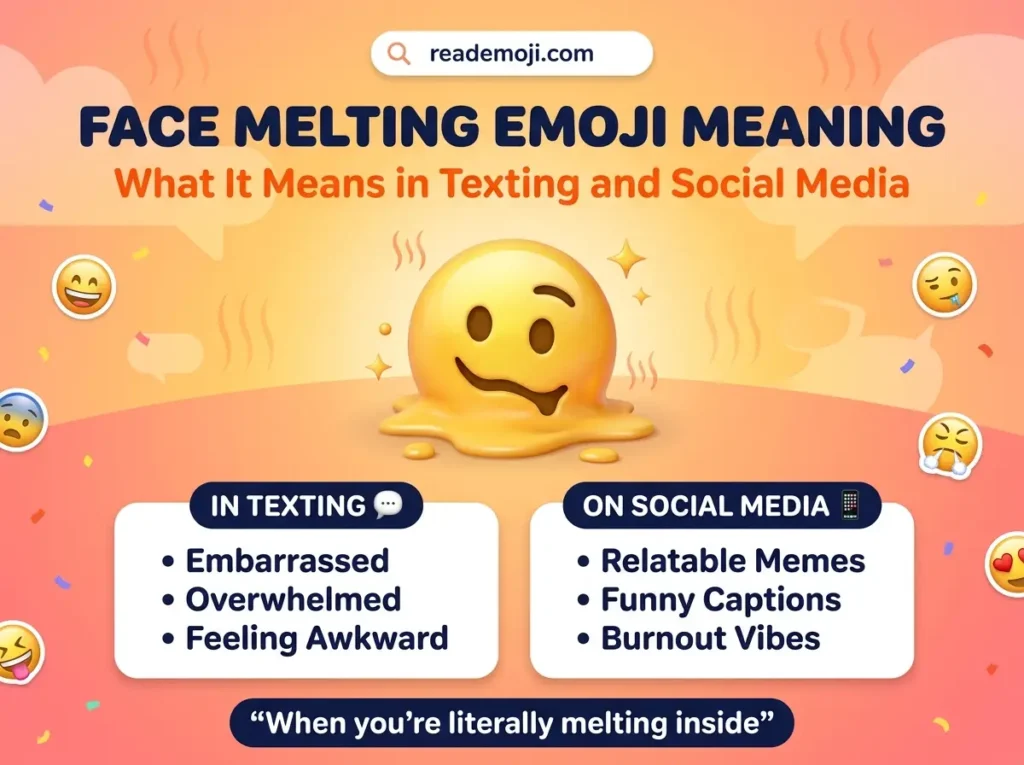
The 🫠 Melting Face Emoji represents embarrassment, awkwardness, exhaustion, or feeling overwhelmed. Often used humorously, it can mean “I’m melting” from heat, stress, cringe, or an uncomfortable situation.
Have you ever received the 🫠 emoji in a text message and wondered what the other person was trying to say? The melting face can look funny, awkward, or even a little dramatic, depending on the conversation. Someone might send it after making an embarrassing mistake, dealing with a stressful situation, or receiving a compliment that leaves them speechless.
The face melting emoji meaning is usually connected to embarrassment, awkwardness, exhaustion, emotional overwhelm, or the feeling of wanting to disappear. It can also express sarcasm when something is so uncomfortable, frustrating, or ridiculous that a person feels like they are melting.
Unlike a smiling face or a red heart, 🫠 can communicate several emotions at once. A friend might use it to joke about a difficult Monday, while someone with a crush might send it after receiving a flirty message. On social media, it can also describe extreme heat, an uncomfortable situation, or a moment when everything feels overwhelming.
So, how do you know what 🫠 means in a particular conversation? The answer depends on the message, the relationship between the people involved, and the situation being discussed.
In this article, you’ll learn what the melting face emoji means, how people use it in texting, what it can mean from a girl or a guy, and how it differs from similar emojis.
Face Melting Emoji Meaning 🫠: Quick Answer
The 🫠 melting face emoji represents feelings such as embarrassment, awkwardness, exhaustion, discomfort, and emotional overwhelm.
People commonly use it when they feel like they are mentally or emotionally melting under pressure. It can also express sarcasm, nervous laughter, extreme heat, or playful embarrassment.
Here are its most common meanings:
- Embarrassment: Feeling awkward after saying or doing something embarrassing.
- Awkwardness: Not knowing how to respond to an uncomfortable situation.
- Exhaustion: Feeling mentally drained or completely worn out.
- Overwhelm: Having too much to handle emotionally or mentally.
- Sarcasm: Reacting humorously to a frustrating or ridiculous situation.
- Flirting: Feeling shy, flustered, or overwhelmed by someone’s attention.
- Heat: Feeling extremely hot, especially during summer.
- Resignation: Accepting an unpleasant situation because there is nothing you can do about it.
For example:
Message: “I accidentally called my teacher Mom in front of the whole class 🫠”
Meaning: The person feels embarrassed and is using humor to make the situation less uncomfortable.
The emoji’s exact interpretation depends on the surrounding conversation. It can express genuine discomfort, but it is also frequently used in a lighthearted, exaggerated way.
What Does the Melting Face Emoji 🫠 Mean?
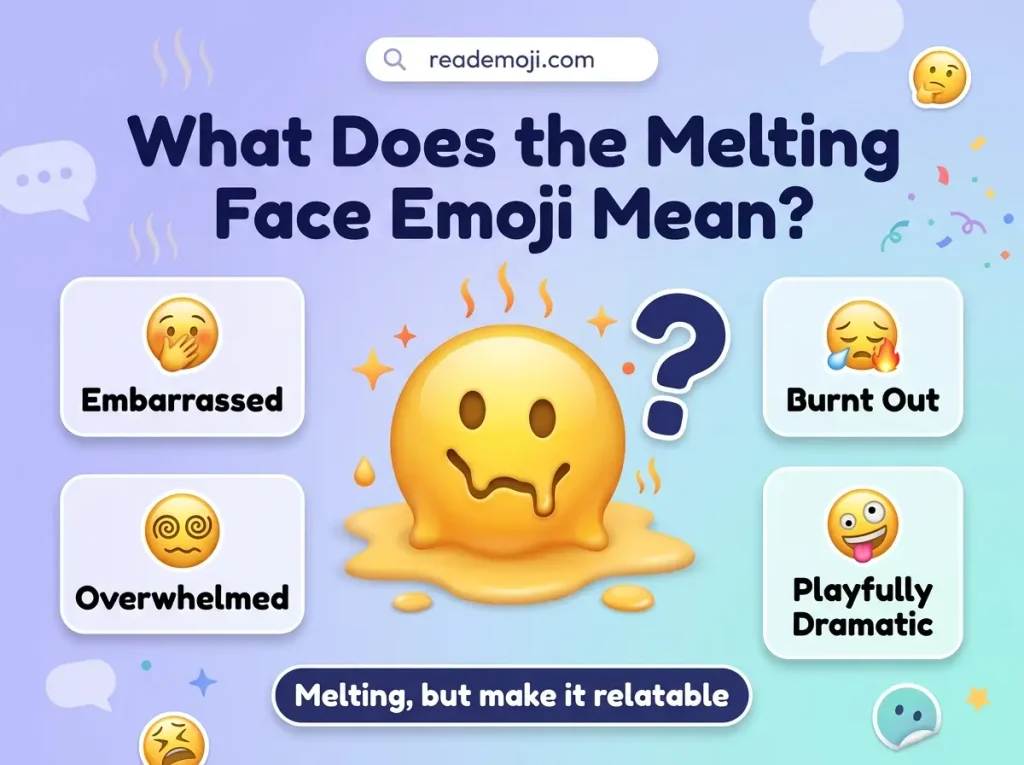
The melting face emoji shows a yellow face with a distorted, melting appearance. Its expression can suggest that the person is losing their composure, struggling to keep it together, or feeling overwhelmed by what is happening.
The emoji is particularly useful because it communicates emotions that ordinary smiling or laughing faces cannot always express.
For example, 😂 usually communicates laughter, while 😭 can represent intense sadness, laughter, or dramatic emotion. The 🫠 emoji occupies a different space: it often expresses the feeling of being so embarrassed, uncomfortable, exhausted, or overwhelmed that you cannot react normally.
1. Embarrassment and Awkwardness
One of the most common uses of 🫠 is to communicate embarrassment.
People might send it after making a mistake, saying something awkward, or realizing they have misunderstood a situation.
Example:
“Just waved back at someone who wasn’t waving at me 🫠”
The sender is acknowledging an awkward moment while making fun of themselves.
The emoji can also soften an embarrassing confession. Instead of sounding overly serious, the person communicates that they recognize the awkwardness and can laugh about it.
2. Feeling Overwhelmed
Sometimes life becomes stressful, and a person feels unable to handle everything happening around them.
The melting face can communicate that feeling without requiring a long explanation.
Example:
“Three deadlines, two exams, and no sleep 🫠”
Here, the emoji suggests mental exhaustion and a sense of being overwhelmed.
It can apply to schoolwork, professional responsibilities, family obligations, or everyday problems.
3. Sarcasm and Dry Humor
The 🫠 emoji is also useful when something is so frustrating or ridiculous that the only reasonable response seems to be humor.
Example:
“My flight was delayed again, and now my connecting flight is leaving without me 🫠”
The sender probably isn’t literally melting. Instead, the emoji communicates frustration with a slightly sarcastic tone.
It can make a complaint sound less aggressive and more conversational.
4. Feeling Flustered by a Compliment
A compliment can sometimes leave someone shy, speechless, or pleasantly overwhelmed.
In these situations, 🫠 may communicate that the person doesn’t know how to respond.
Example:
Ethan: “You looked amazing at the party last night.”
Olivia: “Ethan stoppp 🫠”
Olivia may feel flattered or shy about the compliment. Depending on their relationship, the response could be friendly, playful, or flirtatious.
It does not automatically indicate romantic interest.
5. Physical Heat
The melting face can also be interpreted literally.
People may use it during hot weather, after exercising, or when describing an overheated room.
Example:
“It’s 100 degrees outside, and my car has been sitting in the sun all afternoon 🫠”
Here, the emoji represents the feeling of melting from the heat.
This interpretation becomes more likely when the conversation mentions summer, temperature, sweating, or being outdoors.
6. Accepting an Unpleasant Situation
Sometimes people use 🫠 to express resignation.
They know something is going wrong, but they cannot easily change it.
Example:
“Forgot my umbrella, and it’s pouring outside. Guess I’m walking home in the rain 🫠”
The emoji communicates a mixture of frustration, acceptance, and humor.
This is one reason it works so well in casual conversations: it lets people acknowledge an unpleasant situation without making the message sound overly serious.
What Does 🫠 Mean in Texting and Chat?
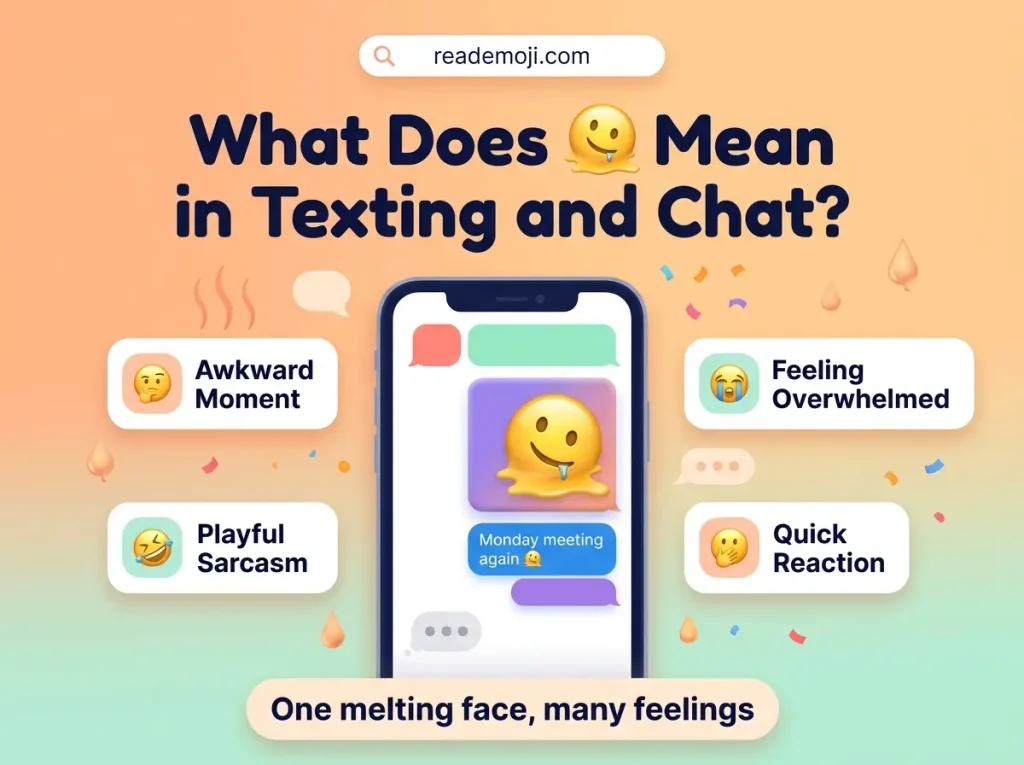
In texting, the melting face emoji usually adds an emotional tone to a message.
A sentence such as “I have a meeting in five minutes” is straightforward. Adding 🫠 can change the tone to suggest nervousness, exhaustion, or dread.
The emoji is commonly useful in text messages, WhatsApp conversations, iMessage chats, Facebook Messenger, and direct messages.
Its meaning often depends on what comes before it.
| Text message | Likely meaning |
|---|---|
| “I sent that text to the wrong person 🫠” | Embarrassment |
| “I have another eight-hour shift tomorrow 🫠” | Exhaustion or dread |
| “Why did he look at me like that 🫠” | Feeling flustered or confused |
| “My phone died right before the interview 🫠” | Frustration and overwhelm |
| “It’s way too hot in here 🫠” | Physical heat |
| “I stayed up until 4 a.m. again 🫠” | Tiredness and regret |
What Does 🫠 Mean at the End of a Message?
When 🫠 appears at the end of a sentence, it often communicates the emotional reaction behind the words.
For example:
“I accidentally liked his photo from 2019 🫠”
The words describe what happened, while the emoji conveys the embarrassment that followed.
It can also make a complaint feel more humorous.
“I have to work this weekend 🫠”
The sender may be disappointed, tired, or reluctant to work.
What Does 🫠 Mean by Itself?
If someone sends only 🫠, the meaning is more dependent on the previous conversation.
They might be reacting to something embarrassing, expressing disbelief, or showing that they are overwhelmed.
For example:
Madison: “Your ex just walked into the restaurant.”
Jake: “🫠”
Jake’s response suggests that he feels awkward, uncomfortable, or unprepared for the situation.
A standalone emoji can be a complete reaction when both people already understand the context.
What Does the Melting Face Emoji Mean From a Girl?
When a girl sends 🫠, she may be expressing embarrassment, awkwardness, exhaustion, nervousness, or playful frustration.
If the conversation involves a compliment or romantic attention, the emoji can also suggest that she feels flustered.
However, the melting face emoji does not automatically mean a girl likes you. The surrounding conversation provides much more useful information than the emoji alone.
If She Sends 🫠 After a Compliment
Suppose you tell her that she looks beautiful, and she responds:
“You’re making me blush 🫠”
She may be feeling shy, flattered, or playfully embarrassed.
If she continues the conversation, compliments you in return, or shows interest in spending time with you, those additional signals may help clarify her intentions.
The emoji itself is not proof of attraction.
If She Sends 🫠 After an Awkward Moment
She might use it to acknowledge an embarrassing experience.
For example:
“I just tripped walking into class 🫠”
In this situation, the emoji is most likely a humorous reaction to her own awkwardness.
If She Sends 🫠 During a Stressful Conversation
She may be communicating that she is tired, frustrated, or overwhelmed.
A considerate response might be:
“That sounds exhausting. Want to talk about it?”
This acknowledges her message without assuming that she is flirting or asking for advice.
What Does the Melting Face Emoji Mean From a Guy?
When a guy sends 🫠, he may be expressing the same general emotions as anyone else: embarrassment, nervousness, exhaustion, awkwardness, or frustration.
The meaning depends on his usual texting style and the situation.
If He Sends 🫠 After You Compliment Him
For example:
You: “You looked really good in that picture.”
Noah: “Okay, now I’m embarrassed 🫠”
He may feel flattered or shy.
If you are already flirting, the response could contribute to a playful romantic exchange. If you are friends, it might simply be a friendly reaction to a compliment.
If He Sends 🫠 During a Difficult Day
A guy might use the emoji to describe stress at work, school, or home.
For example:
“Boss added another project to my workload 🫠”
Here, the emoji communicates frustration or exhaustion rather than romantic interest.
If He Sends Only 🫠
A single melting face might mean he is speechless, uncomfortable, amused, or overwhelmed.
Look at the message immediately before it and consider whether he usually uses emojis this way.
His words and behavior over time are more reliable indicators of his intentions than one emoji.
What Does 🫠 Mean Between Friends?
Among friends, the melting face emoji is often a way to share embarrassment, complain humorously, or acknowledge a ridiculous situation.
It works particularly well when friends already understand each other’s humor.
Common situations include:
- Making an embarrassing mistake in public.
- Staying awake too late.
- Dealing with exams or deadlines.
- Getting caught in an awkward conversation.
- Experiencing an unexpected problem.
- Laughing at a friend’s dramatic story.
Example:
Ryan: “I studied the wrong chapter for the entire exam.”
Chris: “Bro 🫠”
Meaning: Chris is reacting with disbelief and sympathy. The emoji adds a playful sense of secondhand embarrassment.
Friends may also use it when teasing each other.
Example:
Megan: “I practiced my introduction for an hour and still forgot my own name during the presentation 🫠”
Ashley: “PLEASE 😭”
Meaning: Megan is laughing at an embarrassing experience, while Ashley responds with dramatic amusement.
The melting face is especially suitable for moments when something is funny but also painful or uncomfortable.
What Does 🫠 Mean in a Romantic Relationship?
In romantic conversations, 🫠 can communicate feeling flustered, shy, emotionally overwhelmed, or playfully embarrassed.
Couples might use it after receiving an affectionate message, hearing a compliment, or discussing an intimate memory.
For example:
Liam: “I still smile whenever I think about our first date.”
Emma: “You’re making me melt 🫠❤️”
Meaning: Emma is expressing a warm, emotionally affected reaction to Liam’s message. The heart reinforces the affectionate tone.
However, the melting face does not have an inherently romantic meaning.
A partner might also use it when discussing a stressful day:
Emma: “I have back-to-back meetings until 6.”
Liam: “You deserve a relaxing evening after that 🫠”
Here, the conversation is about exhaustion and support rather than flirting.
Does 🫠 Mean Someone Is Flirting?
It can contribute to a flirty tone, especially when it follows a compliment, a teasing remark, or an affectionate message.
Consider these examples:
- “You looked so cute today 🫠”
- “Why are you making me smile at my phone 🫠”
- “Stop being so charming 🫠”
These messages may suggest attraction or playful embarrassment.
Still, the emoji should be interpreted alongside the person’s words, communication habits, and behavior. One emoji cannot establish whether someone has romantic feelings.
What Does 🫠 Mean Between Family Members?
Family members may use 🫠 to communicate exhaustion, embarrassment, frustration, or humor about everyday responsibilities.
Parents might use it when dealing with a busy schedule, while siblings may send it after a funny or awkward family incident.
Example:
Mom: “The entire family is coming over tomorrow, and I still need to clean the house 🫠”
Emily: “I’ll help you after work.”
Meaning: The emoji communicates that Mom feels overwhelmed by the preparations.
Siblings might use it in a more playful way.
Example:
Daniel: “Dad just showed everyone my childhood dance video 🫠”
Michael: “I’m never letting you forget this.”
Meaning: Daniel feels embarrassed, while Michael sees an opportunity for friendly teasing.
In family chats, the emoji can help communicate a feeling without making a minor inconvenience sound too serious.
What Does 🫠 Mean on Instagram, TikTok, Snapchat, and Facebook?
The melting face emoji can appear in social media captions, comments, stories, video reactions, and direct messages.
Although the general meaning remains similar across platforms, the content surrounding it often determines the interpretation.
🫠 Meaning on Instagram
On Instagram, people may use 🫠 in comments, captions, and DMs.
It can express embarrassment, admiration, exhaustion, or a reaction to something impressive.
Examples:
- “This picture is actually perfect 🫠”
- “Posted that story and immediately regretted it 🫠”
- “Monday morning meetings 🫠”
In comments on someone’s photo, it can communicate that the person looks attractive or that the image has left the commenter feeling flustered.
The precise tone depends on the relationship and the rest of the comment.
🫠 Meaning on TikTok
On TikTok, the melting face can accompany relatable videos, awkward situations, dramatic reactions, or jokes about everyday struggles.
For example, someone might comment:
“Me remembering the embarrassing thing I said three years ago 🫠”
The emoji reinforces the familiar feeling of replaying an awkward memory.
It can also appear in reaction videos about school, work, dating, or social situations.
🫠 Meaning on Snapchat
On Snapchat, 🫠 may appear in private messages, replies to snaps, or casual conversations.
Someone might send it after sharing an embarrassing photo or receiving an unexpected message.
For example:
Ava: “I accidentally sent that snap to the group chat.”
Sophia: “No way 🫠”
The emoji communicates surprise and secondhand embarrassment.
🫠 Meaning on Facebook
On Facebook, the melting face may appear in comments, posts, and Messenger conversations.
People often use it to react to frustrating news, funny family stories, difficult days, or uncomfortable situations.
For example:
“Finally finished cleaning the house, and the kids immediately made another mess 🫠”
Here, the emoji expresses humorous exhaustion.
🫠 Meaning in WhatsApp and iMessage
On WhatsApp and iMessage, the emoji often works as a quick emotional reaction.
A person might send it after an awkward confession, a stressful update, or a compliment.
Because these conversations are usually interpreted through shared personal context, the same emoji can feel playful in one chat and genuinely overwhelmed in another.
Real Conversation Examples of the 🫠 Emoji
These examples show how the melting face can communicate different emotions depending on the conversation.
1. Between Friends
Tyler: “I called the waiter ‘Mom’ by accident.”
Brandon: “I’m crying 😭🫠”
Meaning: Brandon finds the situation funny and embarrassing. The melting face suggests secondhand embarrassment.
2. During a Flirty Conversation
Sophia: “You have the nicest smile.”
Ethan: “You’re making me blush 🫠”
Meaning: Ethan may feel flattered or shy. Depending on their relationship, this could be friendly or flirtatious.
3. In a Romantic Relationship
Olivia: “I can’t wait to see you tonight.”
Mason: “You’re making this workday impossible 🫠❤️”
Meaning: Mason is expressing affectionate excitement and playful distraction.
4. In a Family Group Chat
Rachel: “I made dinner, and now everyone wants something different.”
Mom: “Welcome to my life 🫠”
Meaning: Mom is expressing humorous exhaustion about a familiar family situation.
5. During a Stressful Day
Kevin: “The presentation is tomorrow, and my laptop just crashed.”
Andrew: “Please tell me you have a backup 🫠”
Meaning: Andrew is reacting with concern and a sense of impending trouble.
6. After an Embarrassing Mistake
Jessica: “I waved at someone who was waving at the person behind me.”
Lauren: “That’s rough 🫠”
Meaning: Lauren recognizes the awkwardness and responds sympathetically.
7. On Social Media
Mia: “This concert was worth every penny.”
Chloe: “I need to see them live too 🫠”
Meaning: Chloe is expressing excitement and possibly a little envy.
8. During Hot Weather
Daniel: “It’s 102 degrees, and the AC stopped working.”
Ryan: “I’m not leaving the house today 🫠”
Meaning: Ryan is reacting humorously to the heat and uncomfortable conditions.
🫠 vs. Similar Emojis: What’s the Difference?
The melting face can resemble other emotional reaction emojis in how people use it, but each one has a slightly different visual expression and common tone.
| Emoji | Official Name | Common Meaning | Typical Tone |
|---|---|---|---|
| 🫠 | Melting Face | Embarrassment, overwhelm, discomfort, heat | Awkward, sarcastic, resigned |
| 😭 | Loudly Crying Face | Intense sadness, dramatic laughter, overwhelm | Emotional, exaggerated |
| 🥲 | Smiling Face with Tear | Gratitude, bittersweet feelings, holding back emotion | Tender, emotional |
| 🫣 | Face with Peeking Eye | Nervous curiosity, embarrassment, not wanting to look | Shy, anxious, playful |
| 😳 | Flushed Face | Shock, embarrassment, surprise | Startled, flustered |
| 🥵 | Hot Face | Physical heat, attraction, intense effort | Overheated, excited |
| 😵💫 | Face with Spiral Eyes | Confusion, dizziness, disorientation | Overwhelmed, confused |
| 🫥 | Dotted Line Face | Feeling invisible, withdrawn, or awkward | Subdued, uncomfortable |
🫠 vs. 😭
The 🫠 emoji often suggests that someone is struggling to keep it together, while 😭 communicates a more intense emotional reaction.
For example:
“I forgot my homework 🫠”
This suggests embarrassment or mild panic.
“I forgot my homework and it’s worth half my grade 😭”
This communicates a stronger reaction, although both emojis can be used humorously.
🫠 vs. 🥲
The 🥲 emoji combines a smile with a tear, often suggesting bittersweet feelings, emotional gratitude, or trying to smile through a difficult moment.
The melting face more directly suggests discomfort, awkwardness, exhaustion, or emotional overwhelm.
Example:
“Thanks for checking on me 🥲”
This can express appreciation and emotion.
“I have another deadline tomorrow 🫠”
This suggests exhaustion or dread.
🫠 vs. 🥵
These emojis can overlap when someone is talking about hot weather, but their visual expressions differ.
- 🫠 Melting Face: Can represent literal heat, emotional discomfort, embarrassment, or exhaustion.
- 🥵 Hot Face: More directly represents intense heat, sweating, physical exertion, or feeling hot and flustered.
For example, someone describing a heatwave might use either emoji. Someone describing an exhausting workload may find 🫠 more appropriate.
🫠 vs. 🫣
The 🫣 emoji often communicates nervous curiosity, embarrassment, or the feeling of wanting to look away while still watching.
The 🫠 emoji emphasizes the reaction of feeling overwhelmed, awkward, or unable to maintain composure.
Example:
“My crush just walked into the room 🫣”
This suggests nervous anticipation.
“My crush just told me they like me back 🫠”
This suggests feeling flustered or emotionally overwhelmed.
These distinctions are common tendencies rather than strict rules.
What Is the Official Name of 🫠?
The official Unicode emoji name is Melting Face.
The character is represented by the Unicode code point U+1FAE0 and was added to Unicode 14.0 in September 2021. It was also included in Emoji 14.0, released in 2021.
The emoji depicts a yellow face that appears to melt downward. Its visual design can communicate heat, embarrassment, discomfort, exhaustion, or the feeling of losing control of a situation.
The emoji’s appearance may vary slightly across operating systems, applications, and devices. However, it remains the same underlying Unicode character.
It is important to distinguish the official name from the many informal meanings people give it in conversations. Unicode identifies the character as Melting Face, but its interpretation in texting depends on the context.
Common Mistakes People Make When Interpreting 🫠
Even though the melting face is visually distinctive, it can be misunderstood when someone assumes it has only one meaning.
1. Assuming It Always Means Embarrassment
Embarrassment is a common interpretation, but the emoji can also express exhaustion, heat, frustration, or sarcasm.
Read the message before deciding what the sender means.
2. Assuming It Always Means Flirting
A person might use 🫠 after a compliment, but that does not automatically indicate attraction.
Friends, family members, and coworkers can use it in non-romantic conversations.
3. Ignoring the Surrounding Message
The same emoji can have different meanings in different situations.
“You’re so cute 🫠” may sound flirtatious.
“It’s 105 degrees outside 🫠” most likely refers to the heat.
The words around the emoji provide essential context.
4. Treating It as a Sign of Serious Distress
The melting face is often used humorously or dramatically.
However, if someone describes a genuinely difficult situation, do not automatically dismiss their feelings as a joke simply because they use an emoji.
Consider the full message and respond appropriately.
5. Assuming Everyone Uses Emojis the Same Way
Some people use 🫠 frequently as a general reaction, while others reserve it for specific situations.
Understanding someone’s usual texting habits can help you interpret their messages more accurately.
When Should You Use the 🫠 Emoji?
The melting face works best when you want to communicate a feeling of awkwardness, emotional overload, exhaustion, or playful resignation.
You can use it in situations such as:
- Embarrassing moments: “I just walked into the wrong classroom 🫠”
- Busy schedules: “Three meetings before lunch 🫠”
- Flirty conversations: “Why would you say something that cute 🫠”
- Hot weather: “It’s too hot to function today 🫠”
- Funny mistakes: “I sent the screenshot to the person I was talking about 🫠”
- Unexpected problems: “My car won’t start, and I’m already late 🫠”
- Relatable social media posts: “Me remembering every awkward thing I’ve ever said 🫠”
It is particularly useful when you want a message to sound self-aware rather than overly serious.
For example, “I have so much work today” sounds like a straightforward statement. Adding 🫠 can communicate that you feel overwhelmed but are trying to take the situation in stride.
When Should You Avoid Using 🫠?
The melting face is versatile, but it may not suit every conversation.
Formal Workplace Communication
In a formal email to a client, manager, or unfamiliar colleague, the emoji may appear too casual.
Instead of writing:
“I missed the deadline again 🫠”
You could explain the situation professionally and describe the steps you are taking to resolve it.
In an informal team chat, however, the emoji may be perfectly acceptable if your workplace culture is relaxed.
Serious or Sensitive Conversations
If someone shares difficult personal news, 🫠 might seem dismissive if used without care.
A thoughtful message of support is usually more appropriate than a joking reaction.
When Your Meaning Could Be Misunderstood
If you are communicating something important, do not rely on the emoji to convey the entire message.
For example, if you are genuinely overwhelmed and need help, explaining what is happening is clearer than sending only 🫠.
When the Conversation Is Already Uncomfortable
The emoji can help lighten an awkward situation, but it can also make a sensitive exchange seem sarcastic.
Consider the other person’s feelings before using it.
Frequently Asked Questions About the Face Melting Emoji Meaning
1. What does the 🫠 emoji mean in texting?
In texting, 🫠 commonly represents embarrassment, awkwardness, exhaustion, frustration, or feeling emotionally overwhelmed. It can also communicate sarcasm or physical heat. The exact meaning depends on the conversation.
2. What does 🫠 mean from a girl?
A girl may use 🫠 to express embarrassment, nervousness, exhaustion, or feeling flattered. In a romantic conversation, it can suggest that she feels shy or flustered, but it does not automatically mean she is interested in someone.
3. What does 🫠 mean from a guy?
A guy may use the melting face to express awkwardness, stress, embarrassment, or playful frustration. If he sends it after a compliment, he might feel flattered or shy. His intentions depend on the wider conversation.
4. Does the melting face emoji mean love?
Not necessarily. The emoji is not primarily a symbol of love. It can express feeling overwhelmed by affection or a compliment, but romantic meaning usually comes from the surrounding message or other affectionate emojis, such as ❤️.
5. Is 🫠 a flirty emoji?
It can be flirty when used in response to compliments, teasing, or affectionate messages. However, it is also widely useful for ordinary embarrassment, exhaustion, and awkward situations. The context determines the tone.
6. What does 🫠 mean between friends?
Between friends, it commonly communicates secondhand embarrassment, humorous frustration, exhaustion, or a reaction to an awkward situation. It can make a difficult or embarrassing experience feel lighter.
7. What does 🫠 mean on Instagram?
On Instagram, the emoji can appear in comments, captions, stories, and direct messages. People use it to express admiration, awkwardness, exhaustion, or an exaggerated emotional reaction to something they see.
8. What does 🫠 mean when someone sends it alone?
A standalone 🫠 usually acts as a reaction to the previous message. It may mean the person feels embarrassed, overwhelmed, speechless, or uncomfortable. The earlier conversation is usually the best clue.
9. What is the difference between 🫠 and 😭?
The melting face often communicates awkwardness, discomfort, exhaustion, or feeling unable to cope. The loudly crying face can represent intense sadness, dramatic laughter, or emotional overwhelm. Both can be used humorously, depending on the situation.
10. What is the difference between 🫠 and 🥵?
The melting face can represent both emotional discomfort and physical heat. The hot face more directly suggests sweating, high temperatures, physical exertion, or feeling hot and flustered. Their meanings can overlap when discussing hot weather.
11. Can I use 🫠 in a professional conversation?
You can use it in a relaxed workplace chat if emojis are common in your team’s communication. In formal emails, client messages, or sensitive professional discussions, a clear written explanation is usually a better choice.
12. What is the official name of 🫠?
The official Unicode name is Melting Face. Its code point is U+1FAE0, and it was introduced in Unicode 14.0 and Emoji 14.0 in 2021.
Conclusion
The face melting emoji meaning centers on embarrassment, awkwardness, exhaustion, discomfort, and feeling emotionally overwhelmed. People use 🫠 when a situation is so uncomfortable, frustrating, or intense that they feel like they are melting. It can also express playful sarcasm, physical heat, or feeling flustered after receiving a compliment.
In texting, the emoji can make an awkward confession feel humorous, soften a complaint, or communicate a reaction that is difficult to put into words. On Instagram, TikTok, Snapchat, and other social platforms, it often appears in relatable posts, comments, captions, and everyday conversations.
Its meaning can change with the situation. A friend might use it after making an embarrassing mistake, a partner might send it during a flirty exchange, and a coworker might use it to react to an exhausting workday.
The most important thing to remember is that 🫠 does not have one universal emotional meaning. It is not automatically romantic, and it does not always indicate distress.
To understand the melting face emoji correctly, pay attention to the words, the relationship, and the context surrounding it. Those details will usually tell you far more than the emoji alone.
RELATED POST:
Afraid Emoji Meaning : What It Means in Texting and Social Media (2027 Edition)
Tea Emoji Meaning : What It Means in Texting and Social Media (Updated for 2027)

Alex Carter is a writer and content contributor at ReadEmoji.com. He focuses on explaining emoji meanings, common usage, and digital communication in a simple and easy-to-understand way. His goal is to help readers quickly understand what popular emojis mean and how they are commonly used in everyday conversations.