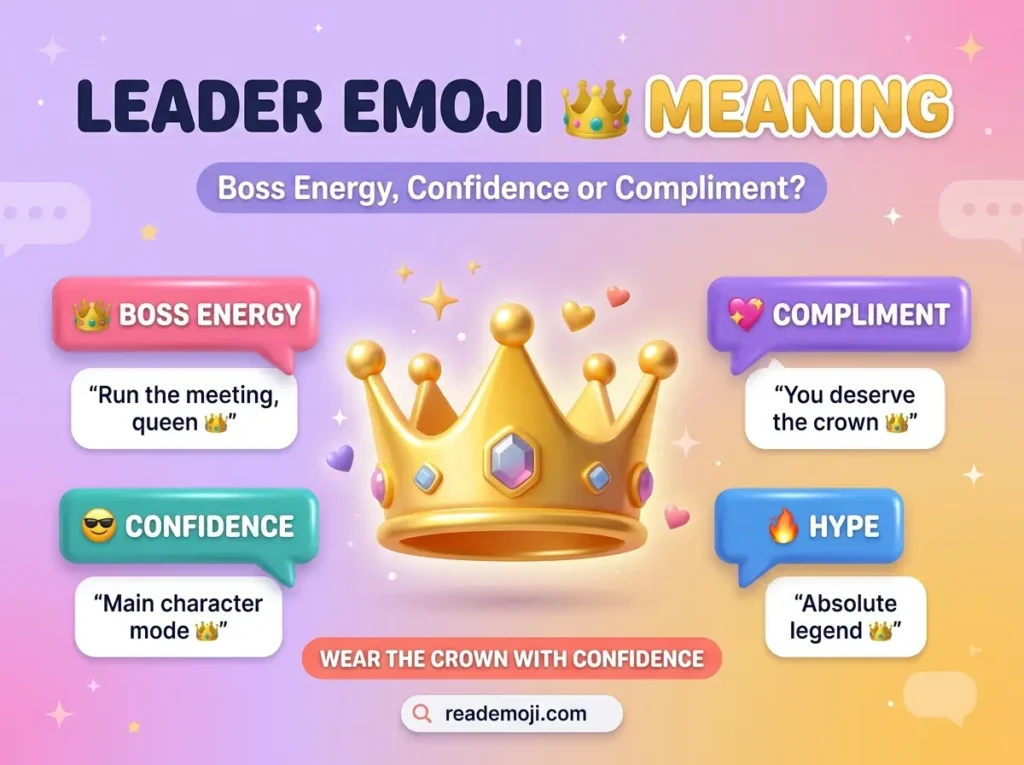
The 👑 Leader Emoji represents leadership, power, confidence, authority, and success. Often used in texting and social media, it symbolizes someone who takes charge, inspires others, or deserves recognition as a king, queen, or true leader.
The leader emoji 👑 is commonly associated with leadership, confidence, success, authority, and being the best at something. People often use it to praise someone, celebrate an achievement, show respect, or playfully call a friend the king or queen of a particular situation.
For example, if your friend helps you through a difficult day, you might text, “You’re the real MVP 👑.” If someone posts an impressive achievement on Instagram, commenting with a crown can be a simple way to show admiration.
However, the meaning depends on the conversation. The crown emoji can express genuine respect, friendly appreciation, romantic admiration, playful confidence, or even sarcasm. It can also represent royalty, luxury, status, and a winning attitude.
One important distinction: 👑 is officially called the Crown emoji, rather than the Leader emoji. Although people may search for it as a leader emoji because of its connection with authority and achievement, its interpretation goes beyond leadership alone.
In this article, you’ll learn what the leader emoji 👑 means, how people use it in text messages, what it can mean from a girl or a guy, how it appears on social media, and how to distinguish it from similar emojis.
Leader Emoji 👑 – Quick Answer
The leader emoji 👑 represents a crown and is commonly used to symbolize leadership, royalty, confidence, achievement, respect, and being the best.
Here are its most common interpretations:
- Leadership: Someone is taking charge or showing strong leadership.
- Respect: You admire someone and recognize their abilities.
- Success: Someone has accomplished something impressive.
- Confidence: A person feels proud, powerful, or self-assured.
- Praise: Someone deserves recognition or special treatment.
- Playful royalty: A friend, partner, or family member is being treated like a king or queen.
- Status and luxury: Something looks prestigious, expensive, or high-quality.
Example:
“Sarah finished the entire project before the deadline. Absolute queen 👑”
Here, the crown emoji expresses admiration for Sarah’s hard work and achievement.
The meaning can change with context. In a supportive message, it may communicate respect. In a flirty conversation, it might suggest admiration. In a sarcastic comment, it could poke fun at someone acting superior.
What Does the Leader Emoji 👑 Mean?
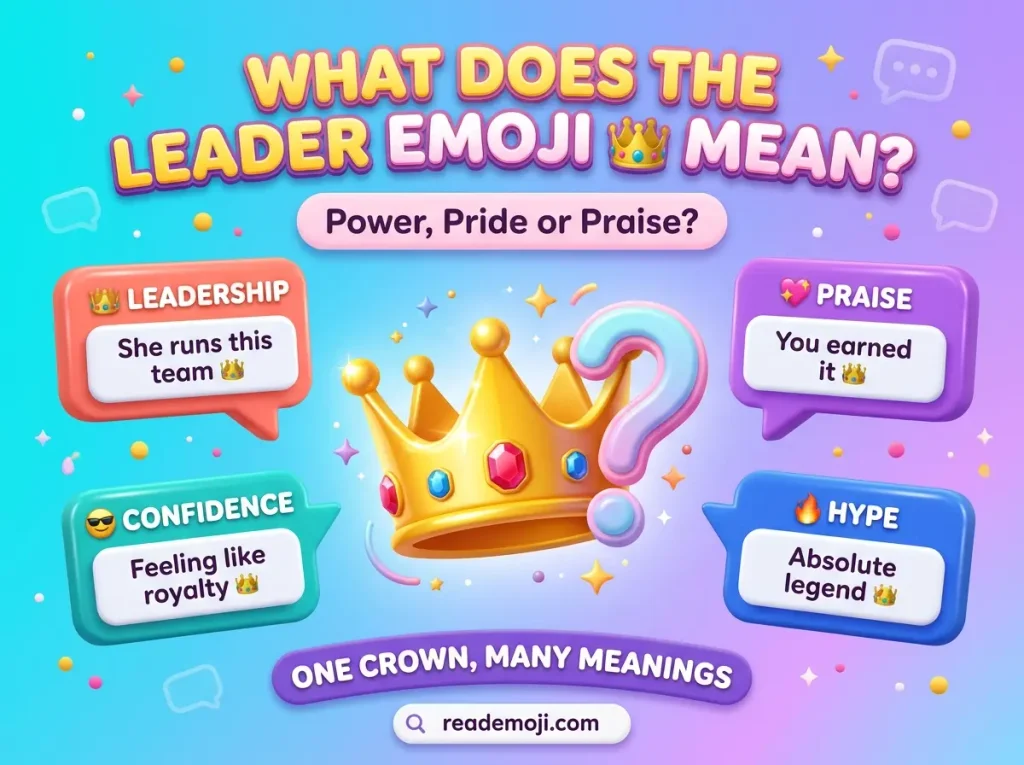
The crown emoji 👑 has several meanings, but most revolve around the ideas of royalty, recognition, power, and excellence. Its exact meaning depends on who sends it, what they are responding to, and the tone of the conversation.
Here are the main interpretations.
1. Leadership and Authority
The crown is a traditional symbol of kings, queens, and monarchs. In digital conversations, it can represent someone who leads others, takes responsibility, or stands out as a natural leader.
For example:
“You handled that meeting perfectly 👑”
This message suggests that the person showed confidence, competence, and leadership.
People may also use the emoji when discussing a team captain, a successful business owner, a community leader, or someone who inspires others.
2. Success and Achievement
The crown emoji can celebrate winning, reaching a goal, or doing something exceptionally well.
For example:
“Finally got promoted! 👑”
Here, the emoji adds a sense of pride and accomplishment. It communicates that the achievement deserves recognition.
It can also accompany exam results, sports victories, business milestones, creative accomplishments, and personal goals.
3. Confidence and Self-Respect
Sometimes, the crown emoji is about how someone sees themselves rather than how others see them.
A person might post:
“Know your worth 👑”
This expresses confidence, self-respect, and the idea that people should recognize their own value.
Depending on the situation, the same emoji can communicate healthy confidence or playful bragging.
4. Admiration and Appreciation
The crown emoji is frequently used to compliment someone.
For example:
“You always show up when I need you. You dropped this 👑”
The phrase suggests that the recipient deserves recognition for being thoughtful, dependable, or supportive.
The emoji can be especially effective as a standalone response when words are unnecessary.
5. Royalty, Luxury, and Status
Because a crown is associated with royalty, the emoji can also suggest wealth, elegance, prestige, or a luxurious lifestyle.
Someone might write:
“Living like royalty this weekend 👑✨”
In this context, the crown adds a glamorous or celebratory feeling. It might accompany a fancy dinner, a luxury hotel, a stylish outfit, or a special occasion.
6. Playfulness and Humor
Not every crown emoji is serious. Friends often use it jokingly to exaggerate someone’s importance or celebrate a small, funny achievement.
For example:
“I found the last slice of pizza. Bow down 👑”
The crown makes the message humorous rather than genuinely authoritative.
The key takeaway: The leader emoji 👑 can express leadership, praise, confidence, success, or humor. The surrounding words usually reveal which meaning fits best.
What Does the Leader Emoji 👑 Mean in Texting and Chat?
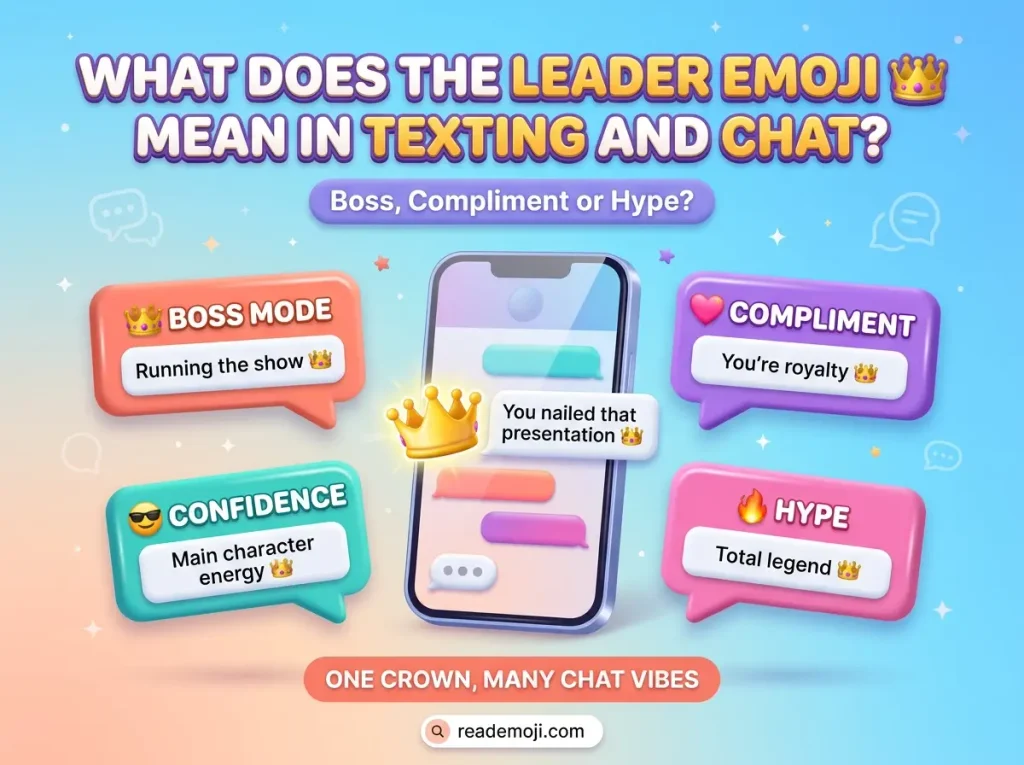
In texting, the crown emoji often works as a quick compliment. It can replace a longer message of appreciation or make an ordinary sentence feel more enthusiastic.
You might see it in text messages, WhatsApp conversations, iMessage, Facebook Messenger, and private social media messages.
Its meaning usually falls into one of these categories.
When someone praises you: They may be saying that you did something impressive or deserve recognition.
Example: “You gave the best advice yesterday 👑”
When someone celebrates you: They may be highlighting an achievement.
Example: “You passed every exam? That’s amazing 👑”
When someone encourages you: They may be reminding you to value yourself.
Example: “Don’t let anyone make you feel small. You know who you are 👑”
When someone jokes with you: They may be exaggerating your importance in a playful way.
Example: “Here comes the king of bad jokes 👑😂”
When someone flirts: They may be complimenting your confidence, appearance, or personality, although the emoji alone does not prove romantic interest.
Example: “Looking like royalty tonight 👑”
Notice how the same symbol takes on a different meaning in each message.
What Does 👑 Mean as a Reply?
If someone sends only 👑 in response to your message, it generally means they approve, admire you, or think you deserve recognition.
For example:
Emily: “I finally stood up for myself.”
Jake: “👑”
Meaning: Jake may be celebrating Emily’s confidence and encouraging her to feel proud of herself.
Another example:
Michael: “I fixed the computer without calling anyone for help.”
Ryan: “👑🔥”
Meaning: Ryan is playfully praising Michael for solving the problem.
A standalone crown is usually positive, but the sender’s usual communication style and the surrounding conversation still matter.
What Does the Leader Emoji 👑 Mean From a Girl?
When a girl sends the crown emoji 👑, she may be expressing admiration, respect, encouragement, affection, or playful teasing.
However, there is no universal meaning based on the sender’s gender. Her relationship with you and the conversation itself provide much more useful clues.
If She Sends 👑 to Compliment You
Suppose she says:
“You really handled that situation well 👑”
She is probably recognizing your confidence or ability to deal with a difficult situation.
The crown acts as a badge of approval.
If She Sends 👑 to a Friend
She might use it to celebrate your achievement, encourage you, or show appreciation for your friendship.
Example:
Ashley: “I finally told my boss I deserved a raise.”
Megan: “YES GIRL 👑”
Meaning: Megan is supporting Ashley and celebrating her confidence.
This is a friendly, empowering use rather than a romantic one.
If She Sends 👑 in a Flirty Conversation
The emoji may add admiration or playful confidence to a romantic conversation.
For example:
Lauren: “You always know how to make me laugh.”
Daniel: “Only for you 👑😉”
Meaning: The crown reinforces a confident, playful tone. Depending on their relationship, the exchange could be flirtatious.
But a crown by itself is not evidence that someone has romantic feelings. Look at the overall conversation, whether the person initiates contact, and how they communicate with you over time.
If She Calls You Her King
If a girl writes “my king 👑,” she may be expressing affection, admiration, or romantic interest.
In an established relationship, it can be an affectionate nickname. Between friends, it might simply be playful praise.
The best interpretation comes from the relationship and the words surrounding the emoji, not from gender alone.
What Does the Leader Emoji 👑 Mean From a Guy?
When a guy sends 👑, he may be showing respect, praising an achievement, expressing affection, or joking with someone.
The emoji is not limited to any gender, and its meaning can range from friendly encouragement to romantic admiration.
If He Sends 👑 After You Achieve Something
For example:
Olivia: “I got the job!”
Ethan: “Let’s gooo 👑🔥”
Meaning: Ethan is celebrating Olivia’s success and expressing excitement.
This is most naturally read as encouragement and praise.
If He Sends 👑 to a Friend
Guys may use the crown emoji to recognize a friend’s loyalty, confidence, humor, or accomplishments.
Example:
Chris: “I covered your shift so you could make it to the game.”
Matt: “You’re a legend 👑”
Meaning: Matt is showing appreciation and respect.
If He Sends 👑 While Flirting
In a romantic conversation, a guy might use the crown emoji to compliment someone or create a confident, playful tone.
Example:
Sophie: “You remembered my favorite coffee order?”
Noah: “Of course. Only the best for you 👑”
Meaning: Noah is being thoughtful and possibly flirtatious. Whether the message signals romantic interest depends on their wider interaction.
If He Calls Himself a King
A message such as “King behavior 👑” may be playful self-praise, confidence, or a joke about doing something impressive.
It can also sound boastful if the surrounding conversation is serious.
Remember: A guy sending 👑 does not automatically mean he is flirting, and a girl sending it does not automatically mean she is interested. Context matters more than gender.
What Does the Crown Emoji Mean Between Friends?
Between friends, 👑 is often a sign of appreciation, loyalty, encouragement, or playful recognition.
Friends might use it to celebrate a promotion, praise someone’s outfit, support a difficult decision, or jokingly recognize the person who always organizes the group.
Here are a few common examples.
Celebrating an achievement
“YOU GOT INTO COLLEGE!! 👑🎉”
The crown emphasizes pride in the person’s success.
Showing appreciation
“You always have my back. Real one 👑”
The emoji reinforces respect and gratitude.
Complimenting a friend
“That outfit is everything 👑🔥”
Here, it expresses admiration for the person’s style.
Giving someone a playful title
“Queen of finding the best restaurants 👑”
This is a humorous way to recognize a friend’s talent.
The crown emoji can make friendships feel more supportive because it adds a visual expression of praise. It does not necessarily imply romance or a special relationship beyond friendship.
What Does the Leader Emoji 👑 Mean in a Romantic Relationship?
In a romantic relationship, the crown emoji can express admiration, affection, respect, or playful devotion.
Partners may use it to make each other feel valued or to acknowledge something the other person has done.
Calling Your Partner a King or Queen
A message such as “Good morning, my queen 👑❤️” can communicate affection and appreciation.
Similarly, “You deserve the world, king 👑” can make a partner feel respected and supported.
Showing Appreciation
A partner might send:
“Thank you for always being there for me 👑❤️”
The crown reinforces the message that the person is important and valued.
Playful Romance
Couples sometimes use the crown emoji in jokes or affectionate exchanges.
For example:
Emma: “I made your favorite dinner.”
Liam: “Marry me again 😂👑❤️”
Meaning: Liam is jokingly praising Emma and expressing affection.
Does 👑 Mean Love?
Not necessarily. The crown emoji is not specifically a love emoji.
It can communicate admiration and affection, but it does not carry the same direct romantic association as ❤️ or 💘.
If someone sends 👑 alongside heart emojis, affectionate words, or a romantic message, the overall combination may suggest love or attraction.
The important distinction is that admiration is not always romantic interest. Someone can think highly of you without wanting a romantic relationship.
What Does the Crown Emoji Mean in Family Conversations?
Family members can use 👑 to celebrate one another, express pride, or give someone a playful royal nickname.
Parents might send it to congratulate a child on a school achievement, while siblings may use it to tease one another or acknowledge a special accomplishment.
Examples include:
- “So proud of you for graduating 👑🎓”
- “Happy birthday to our queen 👑🎂”
- “Dad fixed everything again. The king of DIY 👑😂”
- “You make our family proud 👑❤️”
In these situations, the crown generally expresses pride, affection, or appreciation.
It can also be used humorously for a family member who always gets their way. Whether that feels affectionate or sarcastic depends on the family’s usual sense of humor.
What Does the Leader Emoji 👑 Mean on Social Media?
On social media, the crown emoji is commonly used to praise people, celebrate achievements, signal confidence, and add a sense of status or glamour.
It can appear in captions, comments, usernames, bios, and private messages.
On Instagram, 👑 can appear in selfies, fashion posts, birthday captions, achievement announcements, and comments.
For example:
“Confidence looks good on you 👑✨”
A crown in the comments may mean the person likes your style, admires your confidence, or thinks you deserve recognition.
In a caption, it might represent self-confidence or a celebratory mood.
TikTok
On TikTok, the crown emoji can accompany entertaining videos, impressive performances, confident statements, or posts celebrating someone’s talent.
For example:
“When she finally realizes her worth 👑”
The emoji supports the message of confidence and self-respect.
It may also appear in humorous videos where someone is joking about being the best at something.
Snapchat
On Snapchat, 👑 can be used in captions, snaps, and private conversations to compliment a friend or make a playful statement.
For example:
“Best day with my favorite people 👑❤️”
It adds a celebratory or affectionate tone.
Be careful not to assume that a crown next to a name always has a special relationship meaning. The meaning depends on the context and the specific feature in which it appears.
On Facebook, the crown emoji may accompany birthday wishes, congratulations, family photos, and supportive comments.
For example:
“Congratulations on your new business! 👑🎉”
Here, it recognizes the person’s achievement.
WhatsApp and iMessage
In private messaging apps, the crown emoji often feels more personal because it is part of a direct exchange.
A friend may use it to praise you, a partner may use it affectionately, or a family member may send it to celebrate your success.
The emoji itself does not change meaning from one app to another in a universal way. The people communicating and the surrounding text are usually more important than the platform.
What Does 👑 Mean in an Instagram Bio?
In a bio, the crown may represent confidence, ambition, personal identity, or a royal aesthetic.
For example:
- “Building my own kingdom 👑”
- “Confidence first 👑✨”
- “Queen of my own story 👑”
- “Focused on success 👑”
A crown in a bio does not necessarily mean the person considers themselves superior to others. It may simply be a decorative symbol or a statement of self-confidence.
Real Conversation Examples: How People Use 👑
These examples show how the crown emoji can communicate different things in everyday American English conversations.
1. Between Friends
Jessica: “I finally finished my first 5K!”
Amanda: “Look at you go!! 👑🏃♀️”
Meaning: Amanda is celebrating Jessica’s achievement and showing admiration for her effort.
2. In a Romantic Conversation
Mia: “You always make me feel special.”
Ethan: “Because you deserve it, queen 👑❤️”
Meaning: Ethan is expressing affection and appreciation. In this context, the crown adds a romantic tone.
3. Between Siblings
Tyler: “Mom said I could pick the movie tonight.”
Ashley: “Wow, the king gets his way again 😂👑”
Meaning: Ashley is teasing Tyler about getting to make the decision. The emoji is playful rather than serious.
4. Showing Support
Rachel: “I finally told my friend I couldn’t keep doing everything for her.”
Lauren: “Good for you! Setting boundaries is important 👑”
Meaning: Lauren is encouraging Rachel to respect her own needs and feel confident about her decision.
5. Appreciating Someone’s Help
Kevin: “I fixed the presentation before the meeting started.”
Brian: “You saved us today, man 👑”
Meaning: Brian is recognizing Kevin’s contribution and thanking him for helping the team.
6. On Instagram
Olivia: “Graduated! Four years of hard work finally paid off 🎓”
Madison: “Our girl did it 👑❤️”
Meaning: Madison is celebrating Olivia’s graduation and expressing pride in her accomplishment.
7. Casual Texting
Noah: “I got the last parking spot right in front of the store.”
Jack: “King behavior 👑😂”
Meaning: Jack is jokingly treating Noah as a winner because of his good luck.
8. Flirting
Chloe: “You actually remembered what I told you last week?”
Ryan: “Of course. I pay attention to my favorite person 👑😉”
Meaning: Ryan’s message may be flirtatious because of the affectionate wording and wink. The crown reinforces the playful tone but does not establish romantic interest on its own.
9. Celebrating a Personal Achievement
Emily: “I got the promotion!”
Sarah: “YESSS! You worked so hard for this 👑🎉”
Meaning: Sarah is expressing excitement, pride, and recognition.
10. Responding to a Confident Post
Michael: “Never underestimate what you can accomplish.”
David: “Facts 👑”
Meaning: David agrees with Michael’s message and reinforces its confident, motivational tone.
These examples illustrate an important point: the crown emoji is flexible. The words around it determine whether it feels supportive, romantic, funny, appreciative, or celebratory.
Leader Emoji 👑 vs. Similar Emojis
The crown emoji can appear alongside several other symbols of achievement, royalty, and confidence. Although these emojis sometimes communicate similar ideas, each has its own emphasis.
| Emoji | Name | Common Meaning | Typical Tone |
|---|---|---|---|
| 👑 | Crown | Royalty, confidence, praise, status | Confident, admiring |
| 🏆 | Trophy | Achievement, victory, winning | Celebratory |
| 🥇 | 1st Place Medal | First place, excellence, top performance | Competitive, proud |
| 🤴 | Prince | Royalty, a royal male figure | Playful, regal |
| 👸 | Princess | Royalty, a princess, a queen-like identity in casual usage | Sweet, playful |
| 🫅 | Person with Crown | A person wearing a crown; royalty | Regal, expressive |
| 💪 | Flexed Biceps | Strength, effort, determination | Motivational |
| ⭐ | Star | Excellence, recognition, being outstanding | Positive, encouraging |
| 🔥 | Fire | Something impressive, exciting, or attractive | Energetic, enthusiastic |
| 💎 | Gem Stone | Value, rarity, quality, luxury | Admiring, stylish |
These are common interpretations rather than fixed definitions.
👑 Crown vs. 🏆 Trophy
The crown emoji emphasizes royalty, status, confidence, or a person’s outstanding qualities. The trophy emoji focuses more directly on winning, achievement, or recognition for a particular accomplishment.
For example:
- “You’re a natural leader 👑” emphasizes leadership.
- “We won the championship 🏆” emphasizes victory.
Both can praise someone, but the crown is often more personal, while the trophy is more achievement-oriented.
👑 Crown vs. 🥇 First Place Medal
The first-place medal represents coming first or performing better than others in a competition. The crown can communicate excellence without necessarily implying a competition.
For example:
- “First place in the tournament 🥇” identifies a competitive result.
- “The best teammate anyone could ask for 👑” expresses admiration without ranking people.
👑 Crown vs. 🤴 Prince and 👸 Princess
The crown emoji depicts a crown by itself. The prince and princess emojis depict people associated with royalty.
Use 👑 when you want to emphasize status, recognition, or a metaphorical king or queen. Use 🤴 or 👸 when the person or royal character is the main focus.
👑 Crown vs. 🫅 Person with Crown
These emojis are related but technically different.
- 👑 Crown: A crown as an object or symbol.
- 🫅 Person with Crown: A person wearing a crown.
If you want to describe someone as regal, 🫅 may be more literal. If you want to praise someone’s achievement or confidence, 👑 is often a natural choice.
The two symbols can also be used together: “You deserve this recognition 🫅👑.”
Official Unicode Information About the Crown Emoji 👑
Although people sometimes call 👑 the leader emoji, its official Unicode name is CROWN. The Unicode Consortium lists it under the clothing and accessories symbols. Unicode
Here are the key technical details:
| Detail | Information |
|---|---|
| Emoji | 👑 |
| Official Unicode name | CROWN |
| Unicode code point | U+1F451 |
| Unicode version | Unicode 6.0 |
| Emoji version | Emoji 1.0 |
| Original emoji addition | Emoji 0.6, in 2010 |
| General category | Objects |
| Common associations | Royalty, kings, queens, status, winning |
The crown character was included in Unicode 6.0 in 2010 and later became part of Emoji 1.0 in 2015. These are separate milestones: the first concerns its inclusion in Unicode, while the second identifies its inclusion in the standardized emoji set. Emojipedia
Does the Crown Emoji Look the Same on Every Device?
Not exactly. Apple, Google, Microsoft, and other platform vendors can display their own artwork for the same Unicode character.
The crown may differ in its shape, jewel placement, shading, and gold color. However, these visual differences do not change its underlying Unicode identity.
Unicode standardizes the character’s identity, not a single universal illustration. Unicode
This distinction is useful when explaining emoji meanings: the same crown emoji can look slightly different across devices while still representing the same character.
Common Misunderstandings About the Leader Emoji 👑
The crown emoji is easy to interpret in many situations, but a few common mistakes can lead to confusion.
1. Assuming It Always Means Leadership
Although 👑 can represent leadership, people frequently use it to praise someone’s appearance, celebrate an achievement, or make a joke.
For example, “That haircut looks amazing 👑” is a compliment, not a statement about leadership.
2. Assuming It Always Means Romantic Interest
Someone calling you “king” or “queen” may be expressing affection, but the same language is common among friends.
A crown emoji alone cannot establish whether someone has a crush on you.
3. Confusing Confidence With Arrogance
A person might use 👑 to express self-respect or confidence. That does not necessarily mean they believe they are better than everyone else.
However, if the message sounds boastful or dismissive, the crown could reinforce an arrogant tone.
4. Ignoring the Words Around It
Compare these messages:
- “You handled that perfectly 👑” — praise.
- “Oh, look who’s the king now 👑😂” — playful teasing.
- “Everyone must listen to me 👑” — possibly boastful or authoritarian.
The same emoji takes on different shades of meaning because the words and tone change.
5. Assuming Everyone Interprets It the Same Way
Emoji habits vary from person to person. Some people use crowns frequently as casual compliments, while others reserve them for achievements or special occasions.
If you’re unsure what someone means, consider the conversation rather than relying on a universal definition.
6. Treating Every Crown as a Status Symbol
A crown in someone’s username, profile picture, or bio might be decorative. It may communicate a personal style, a love of royal imagery, or a playful online identity.
It does not automatically indicate wealth, authority, or social status.
When Should You Use the Leader Emoji 👑?
The crown emoji is a natural choice when you want to recognize someone’s value, express confidence, or add a playful royal touch to a message.
Here are situations where it works particularly well.
To celebrate success
“Congratulations on your new job! 👑🎉”
Use it when someone achieves a goal or reaches an important milestone.
To compliment a friend
“You always know exactly what to say 👑”
It adds warmth and appreciation to an ordinary compliment.
To encourage someone
“Keep going. You’re capable of more than you think 👑”
The emoji reinforces confidence and encouragement.
To express self-respect
“Protect your peace and know your worth 👑”
It adds an empowering tone to a motivational message.
To show affection to a partner
“Goodnight, my queen 👑❤️”
In a romantic relationship, it can communicate affection and admiration.
To celebrate a personal style
“This outfit deserves its own runway 👑✨”
Use it when something looks particularly impressive or stylish.
To joke with friends
“The official king of ordering takeout 👑😂”
The crown adds humorous exaggeration.
To recognize a colleague’s achievement
“Fantastic presentation today. You really delivered 👑”
This can work in a friendly, informal workplace conversation.
The general rule is simple: use 👑 when you want to express praise, recognition, confidence, or playful admiration.
When Should You Avoid Using the Crown Emoji 👑?
The crown emoji is versatile, but it is not appropriate for every conversation.
Formal Business Communication
In a formal email to a client, executive, or unfamiliar professional contact, 👑 may feel too casual.
Instead of writing:
“Congratulations on the promotion 👑”
you could simply write:
“Congratulations on your well-deserved promotion.”
The emoji is not inherently inappropriate at work, but your organization’s communication style matters.
Serious or Sensitive Conversations
If someone is sharing painful news, describing a difficult experience, or asking for serious advice, a crown emoji may seem out of place unless it directly supports what you’re saying.
A sincere written response is often more appropriate.
Conversations About Authority or Conflict
If a disagreement involves leadership, power, or decision-making, using 👑 sarcastically may make the conversation more confrontational.
For example, “Because you’re the king, right? 👑” could sound mocking rather than playful.
When You Don’t Know Someone Well
A crown can sound overly familiar if you use it with someone who prefers formal communication.
This is especially relevant when messaging a new colleague, a professional contact, or someone you have only recently met.
When the Meaning Could Be Misleading
If you want to express romantic interest, a crown alone may not communicate your feelings clearly.
Likewise, if you’re congratulating someone on a specific achievement, words explaining what you’re celebrating can make your message more meaningful.
The goal is not to avoid the emoji. It’s to make sure its tone fits the relationship and situation.
Frequently Asked Questions About the Leader Emoji 👑
1. What does the leader emoji 👑 mean?
The leader emoji 👑 usually represents royalty, leadership, confidence, respect, success, or being the best at something. Its meaning depends on the conversation. People often use it to praise someone or celebrate an achievement.
2. What is the official name of the leader emoji?
Its official Unicode name is CROWN. The emoji represents a crown and is commonly associated with royalty, kings, queens, status, and winning.
3. What does 👑 mean in texting?
In texting, 👑 commonly expresses admiration, approval, confidence, or playful praise. Someone might send it after you accomplish something impressive or make a confident statement.
4. What does 👑 mean from a girl?
A girl may use 👑 to compliment you, celebrate your success, show friendly appreciation, or flirt. The emoji alone does not establish romantic interest. Her wording and your relationship provide important context.
5. What does 👑 mean from a guy?
A guy may use the crown emoji to show respect, praise an achievement, support a friend, or express affection. In a romantic conversation, it can add a playful or admiring tone, but it does not automatically mean he is interested in you.
6. Does the crown emoji mean love?
Not specifically. The crown emoji can express admiration and affection, but it is not primarily a symbol of love. When combined with ❤️ or affectionate language, it may contribute to a romantic message.
7. What does 👑 mean between friends?
Between friends, the crown emoji often means someone deserves recognition, respect, or praise. Friends may use it to celebrate achievements, compliment each other’s style, or joke about someone being the best at something.
8. What does 👑 mean on Instagram?
On Instagram, 👑 commonly appears in comments, captions, bios, and direct messages. It can represent confidence, admiration, achievement, personal style, or a playful royal identity.
9. What does it mean when someone sends only 👑?
A standalone crown usually communicates approval, admiration, or praise. For example, someone might send it after you share good news or describe something you accomplished. The exact interpretation depends on what came before it.
10. What is the difference between 👑 and 🏆?
The crown emoji 👑 emphasizes royalty, status, confidence, or personal admiration. The trophy emoji 🏆 more directly represents winning, achievement, or success in a competition. Both can celebrate someone, but they emphasize different ideas.
11. Can I use the crown emoji in professional messages?
Yes, in an informal workplace where emojis are welcome. It can acknowledge a colleague’s achievement or celebrate a team success. In formal emails, client communications, or sensitive discussions, words alone may be more appropriate.
12. Does 👑 have the same meaning on every platform?
Its underlying Unicode identity remains the same, but its appearance can vary between devices and platforms. Its conversational meaning is also flexible, so the surrounding words and the sender’s communication habits matter.
Conclusion
The leader emoji 👑 is a versatile symbol of leadership, confidence, royalty, achievement, and appreciation. Although its official name is the Crown emoji, people commonly use it to recognize someone who stands out, deserves praise, or has accomplished something impressive.
In text messages, the crown can communicate respect or playful admiration. Between friends, it often celebrates achievements and loyalty. In romantic relationships, it may express affection, while on social media, it can represent confidence, personal style, or success.
The most important thing to remember is that 👑 does not have one fixed meaning in every conversation. A crown sent after exciting news will probably feel celebratory, while one added to a sarcastic message may communicate teasing or criticism. Similarly, receiving it from a girl or a guy does not automatically indicate romantic interest.
When interpreting the crown emoji, pay attention to the words surrounding it, your relationship with the sender, and the tone of the conversation. When using it yourself, choose situations where its confident, appreciative, or playful meaning feels natural.
Ultimately, 👑 is a simple way to tell someone they deserve recognition—whether you’re celebrating a major achievement, complimenting a friend, supporting a partner, or jokingly crowning someone the king or queen of the moment.
RELATED POST:
Couple Emoji Meaning: What It Means in Texting and Social Media (Revised for 2027)
Emoji Cat Porn: Meaning, Search Intent, and Online Usage (2027 Explained)

Alex Carter is a writer and content contributor at ReadEmoji.com. He focuses on explaining emoji meanings, common usage, and digital communication in a simple and easy-to-understand way. His goal is to help readers quickly understand what popular emojis mean and how they are commonly used in everyday conversations.