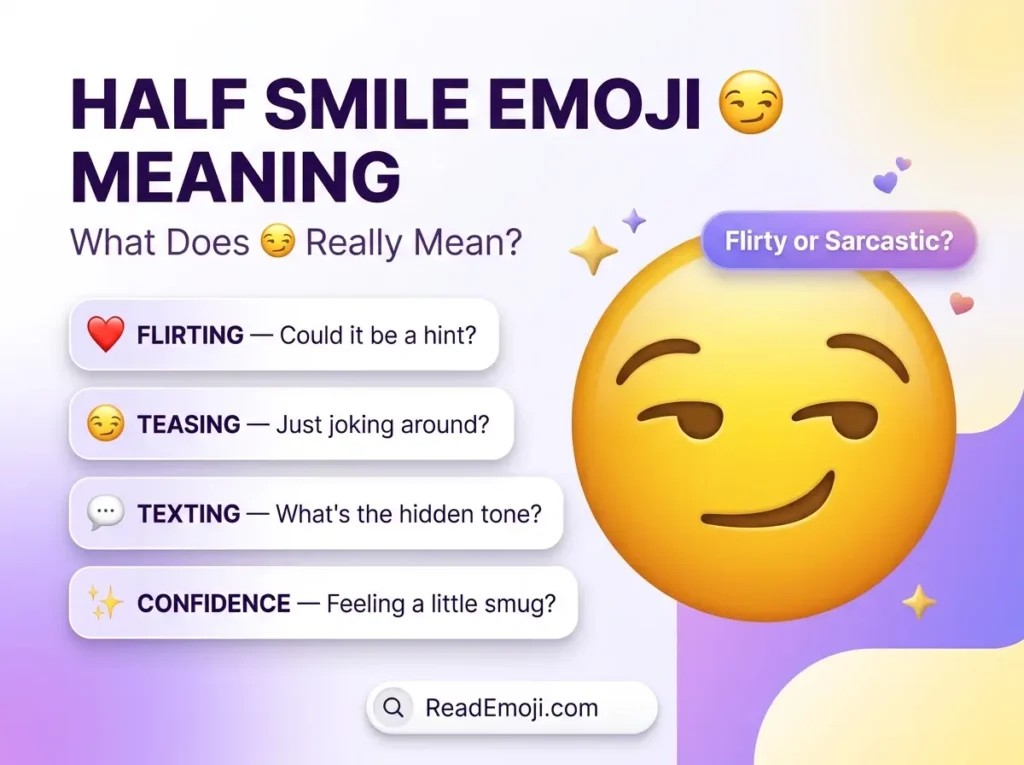
The 😏 Half Smile Emoji represents flirting, confidence, sarcasm, and playful mischief. Often used in texting and social media, it adds a cheeky or suggestive tone to messages, hinting at teasing, hidden intentions, or knowing something others don’t.
The half smile emoji 😏 can make a simple message feel playful, confident, flirty, or even a little sarcastic. Its meaning often depends on the words around it, the relationship between the people texting, and the situation in which it appears.
For example, when someone replies, “I know something you don’t 😏,” the emoji can suggest a secret, a playful tease, or a hint that the sender has something interesting in mind. In a romantic conversation, it might make a message feel flirtatious. Between friends, it can add humor or a cheeky attitude.
But what does the half smile emoji mean when a girl sends it? What about when a guy uses it, or when you see it in an Instagram comment or Snapchat message?
Understanding the difference between a playful smirk, a flirty hint, and a sarcastic reaction can help you interpret the message more accurately. Below, you’ll learn the most common meanings of the half smile emoji, how people use it in different relationships, and how it compares with similar emojis.
Half Smile Emoji 😏 – Quick Answer
The half smile emoji 😏, officially called the Smirking Face, usually expresses a cheeky, confident, mischievous, or suggestive attitude. It can also communicate flirting, sarcasm, teasing, or quiet satisfaction. Emojipedia
Here is what it commonly means in different situations:
- Flirting: “You look amazing 😏”
- Playful teasing: “I knew you’d say that 😏”
- Confidence: “Just wait until you see what I can do 😏”
- Sarcasm: “Oh, sure, because that worked so well last time 😏”
- A secret or hint: “Maybe I have a surprise for you 😏”
- Self-satisfaction: “Told you I was right 😏”
The key takeaway: 😏 often adds a knowing, cheeky, or suggestive tone to a message. It can be flirty, but it does not automatically mean romantic interest. The surrounding conversation matters more than the emoji alone.
What Does the Half Smile Emoji 😏 Mean?
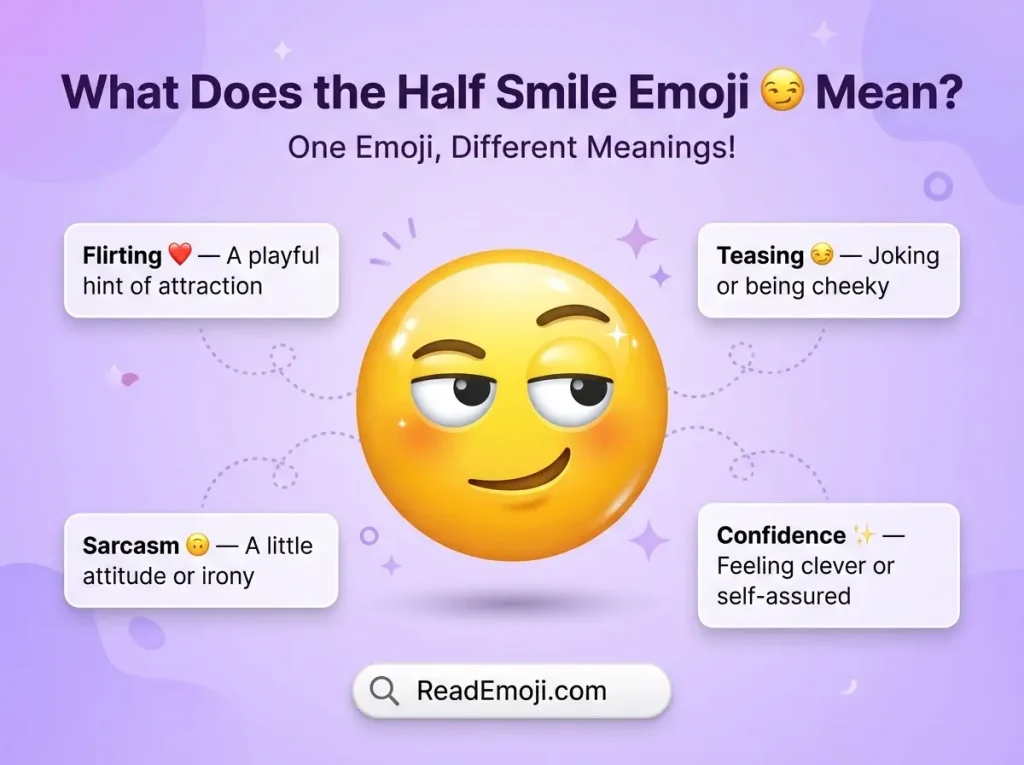
The half smile emoji shows a yellow face with a sideways-looking gaze, raised eyebrows, and an uneven smile. Unlike a straightforward happy face, its expression can suggest that the sender knows something, is hinting at something, or finds a situation amusing in a slightly mischievous way.
Its meaning generally falls into six categories.
1. Flirting and Attraction
One of the most recognizable uses of 😏 is flirting.
Someone might add it to a compliment, a playful question, or a message that hints at romantic interest. The emoji makes the words feel more suggestive than they might sound on their own.
Example:
“I was hoping you’d text me tonight 😏”
The sender may be expressing attraction or inviting a flirtatious response. However, the same message could also be friendly teasing, especially between people who regularly joke around.
2. Playfulness and Mischief
The half smile emoji can suggest that someone is being cheeky or planning something amusing.
For example:
“Guess who’s bringing the good news 😏”
Here, the sender appears to be teasing the recipient or building anticipation. The message does not necessarily have anything to do with romance.
This use is common among friends who enjoy joking, playful challenges, and lighthearted conversations.
3. Confidence and Self-Satisfaction
Sometimes, 😏 communicates a confident attitude.
Imagine that you predicted the winner of a game and turned out to be correct. You might text:
“What did I tell you? 😏”
The emoji adds a little smugness, suggesting that you expected to be right. Depending on your relationship with the recipient, it can sound funny and charming or slightly boastful.
4. Sarcasm and Dry Humor
The half smile emoji can make a sarcastic statement more obvious.
For example:
“Wow, another meeting that could have been an email 😏”
The sender is probably making a dry joke rather than expressing genuine excitement.
It can also soften criticism by making the message feel teasing instead of completely serious. Still, sarcasm does not always come across as intended, particularly when the recipient cannot hear the sender’s voice.
5. Suggestive or Naughty Hints
In some conversations, 😏 has a suggestive meaning. It can imply that a message has a second meaning or that the sender is hinting at something intimate.
For example:
“You’ll find out when you come over 😏”
Depending on the relationship and previous messages, this could suggest a surprise, a playful secret, or flirtation with a more intimate undertone.
The emoji alone does not establish what the sender has in mind. Avoid assuming a sexual meaning without supporting context.
6. Knowing Something Others Don’t
The half smile emoji can also communicate a knowing look, a private joke, or a hint that the sender has information they are not ready to reveal.
For example:
“I have a feeling you’re going to love what I bought 😏”
This use creates curiosity. The sender may be teasing the recipient about a gift, a plan, or a surprise.
Why Does the Half Smile Emoji Have Different Meanings?
Facial expressions can communicate several emotions at once, and the smirk is particularly ambiguous. It can look playful, confident, amused, smug, or suggestive.
In face-to-face conversation, tone of voice and body language help explain what someone means. In texting, 😏 often fills part of that gap.
The most useful clues are the words in the message, the nature of your relationship, the conversation immediately before it, and the sender’s usual communication style.
What Does the Half Smile Emoji 😏 Mean in Texting and Chat?
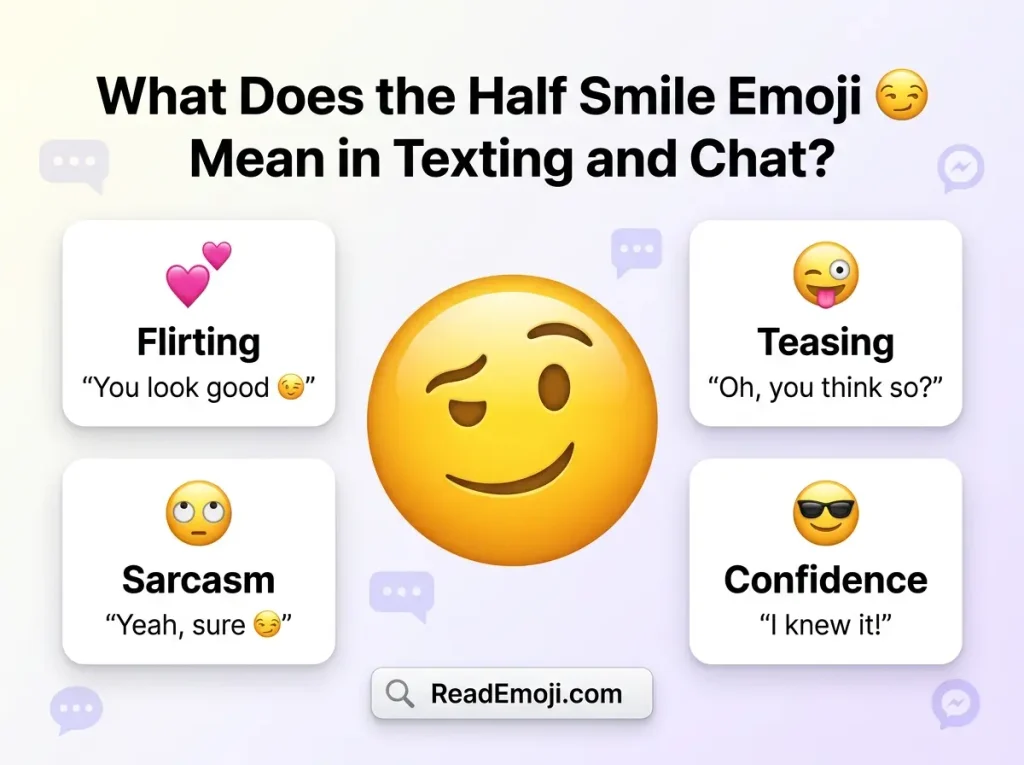
In texting, the half smile emoji usually adds a cheeky or knowing tone to a sentence. It can make a message sound playful, confident, sarcastic, or flirtatious.
People use it in text messages, WhatsApp chats, iMessage conversations, Facebook Messenger, and private DMs.
Here are some common examples.
| Text message | Possible meaning |
|---|---|
| “You miss me already? 😏” | Flirting or playful teasing |
| “I knew you’d agree 😏” | Confidence or satisfaction |
| “I’ve got a surprise for you 😏” | Creating curiosity |
| “You’re not as innocent as you look 😏” | Cheeky teasing or flirtation |
| “Well, that went exactly as planned 😏” | Satisfaction or sarcasm |
| “Maybe I’ll tell you later 😏” | A playful hint or secret |
On WhatsApp
On WhatsApp, 😏 can add personality to otherwise ordinary messages.
A friend might use it after winning an argument, while a romantic partner might add it to a playful compliment. In a family group chat, it could signal a harmless joke or a knowing response to a familiar situation.
Example:
Megan: “I finished the entire project before the deadline.”
Jake: “Look at you being all productive 😏”
Meaning: Jake is probably teasing Megan in a friendly way. The emoji adds a cheeky tone rather than expressing straightforward admiration.
On iMessage
In iMessage, the half smile emoji can change how a short response feels.
Consider the difference between these replies:
- “I know.”
- “I know 😏”
The second version may sound more playful or smug. Depending on the conversation, it could suggest confidence, flirtation, or a private joke.
In Private Messages and DMs
In Instagram DMs and other private chats, 😏 often appears when someone wants to make a message feel less formal and more suggestive.
For instance:
“So, when are you taking me out? 😏”
This could be a direct flirtatious hint, particularly if the conversation already involves dating. However, it could also be a joke between friends.
A useful rule: Read the message without the emoji first, then consider what 😏 adds to its tone. This can help you distinguish the literal message from the sender’s possible implication.
What Does the Half Smile Emoji 😏 Mean From a Girl?
When a girl sends 😏, she may be flirting, teasing, showing confidence, making a sarcastic comment, or hinting at something she finds amusing.
The emoji is not proof that she likes you romantically. Her intended meaning depends on your relationship, the conversation, and how she normally communicates.
1. She May Be Flirting With You
Suppose you compliment her and she responds:
You: “You looked amazing at the party.”
Emily: “Oh, you noticed? 😏”
Her response could be playful flirting. She acknowledges your compliment while encouraging the conversation to continue.
If she regularly initiates conversations, asks to spend time with you, and responds warmly, those broader patterns may provide more useful information than one emoji.
2. She May Be Teasing You
A girl might send 😏 after catching you making an excuse or joking about something you said.
Example:
You: “I wasn’t waiting for your reply.”
Olivia: “Sure you weren’t 😏”
Here, the emoji makes her response sound knowing and teasing. It does not necessarily indicate attraction.
3. She May Be Showing Confidence
She could also use the emoji to celebrate a small victory.
For example:
“Told you I’d get the highest score 😏”
This communicates satisfaction or a playful sense of achievement, not romantic interest.
4. She May Be Suggesting Something
If she sends a suggestive message with 😏, she may be hinting at a romantic or intimate idea.
However, do not jump to conclusions. If you are unsure, respond naturally or ask what she means.
Bottom line: A half smile from a girl can be flirty, friendly, sarcastic, or simply playful. The surrounding words and her overall behavior are more reliable clues than the emoji by itself.
What Does the Half Smile Emoji 😏 Mean From a Guy?
When a guy sends 😏, he may be expressing confidence, flirting, teasing, or a cheeky sense of humor.
Its meaning is not fundamentally different from when a girl uses it. People of any gender can use the emoji in the same ways.
1. He Might Be Interested in You
Imagine that you have been talking to someone you like, and he sends:
“You should let me take you out sometime 😏”
The message itself suggests romantic interest, while the emoji adds a playful, confident tone.
In this situation, the words provide stronger evidence of his intentions than the emoji alone.
2. He Could Be Joking Around
A guy might use 😏 when teasing a friend about a familiar habit or an embarrassing moment.
Example:
Ryan: “You said you were going to bed two hours ago.”
Chris: “And yet, here you are online too 😏”
The emoji adds a playful challenge. There is no necessary romantic meaning.
3. He May Be Feeling Proud of Himself
For example:
“Three goals in one game. Not bad, right? 😏”
Here, the emoji conveys confidence and a little self-satisfaction.
4. He Could Be Making a Suggestive Comment
In an established romantic conversation, 😏 may accompany a suggestive joke or an intimate hint. But the interpretation should come from the message as a whole, not from the assumption that guys use this emoji for one particular reason.
Bottom line: When a guy sends 😏, consider what he actually wrote, whether the conversation is already flirtatious, and whether his behavior consistently suggests interest.
What Does the Half Smile Emoji Mean Between Friends?
Between friends, 😏 often communicates playful teasing, mock confidence, sarcasm, or an inside joke.
It can help friends convey an attitude that would otherwise be difficult to express through plain text.
For example:
Ashley: “I finished the last slice of pizza.”
Lauren: “I knew you couldn’t resist 😏”
The emoji makes the response feel cheeky and familiar.
Friends might also use it after winning a video game, making a clever joke, or correctly predicting something.
Does It Mean Something Different Between Best Friends?
Not necessarily. Best friends may use 😏 more comfortably because they already understand each other’s humor.
For example:
“I know your secrets 😏”
Between close friends, this might refer to an inside joke. Between people who barely know each other, the same message could feel mysterious or suggestive.
The main distinction is familiarity: The more established the relationship, the easier it may be to understand whether the smirk is playful or serious.
What Does the Half Smile Emoji Mean in a Romantic Relationship?
In a romantic relationship, 😏 can add flirtation, playful confidence, or a teasing undertone to a message.
Partners might use it when joking about a date, recalling a private moment, or hinting at something fun they have planned.
For example:
Ethan: “I booked us a table at your favorite restaurant.”
Sophia: “Trying to impress me? 😏”
Meaning: Sophia is playfully acknowledging Ethan’s effort. Her response could be affectionate and flirtatious.
The emoji can also add humor to an everyday exchange:
“You owe me a movie night after making me watch your favorite show 😏”
Here, the smirk makes the request sound teasing rather than demanding.
Does 😏 Mean Love?
Not by itself. The half smile emoji is not primarily a symbol of love or affection in the same way that a heart emoji often is.
It can accompany romantic messages, but it more directly conveys an attitude such as cheekiness, confidence, or suggestiveness.
If someone wants to express affection more clearly, they might use ❤️, 🥰, or 😘, depending on the tone they want.
What Does the Half Smile Emoji Mean in Family Conversations?
In family chats, 😏 often communicates playful mischief, gentle sarcasm, or a knowing response.
A sibling might use it to tease another sibling, while a parent might send it after correctly predicting what their child would do.
Example:
Mom: “You said you weren’t hungry, but you ate all the cookies.”
Daniel: “They were just sitting there 😏”
Meaning: Daniel is jokingly defending himself. The emoji adds a cheeky tone.
Family members may also use it to celebrate small victories or tease each other about familiar habits.
Because family communication often includes shared jokes and long-standing relationships, the same emoji can feel affectionate in one conversation and sarcastic in another.
Can You Use the Half Smile Emoji at Work?
Yes, but context matters.
Among colleagues who regularly joke with each other, 😏 may communicate lighthearted confidence or friendly teasing. In a professional environment, however, the emoji can be misinterpreted as sarcasm, smugness, or flirtation.
For example, consider this message:
“I finished the presentation ahead of schedule 😏”
A close teammate might interpret it as a playful celebration. A manager who does not know the sender well might find it unnecessarily smug.
Similarly, using 😏 in a message to a client could make a straightforward business discussion feel too casual.
For professional communication, a simple sentence or a more neutral emoji is often safer when the relationship is formal.
Practical tip: Use the half smile emoji at work only when you are confident the recipient will understand your intended tone.
What Does the Half Smile Emoji Mean on Social Media?
The half smile emoji appears in social media captions, comments, stories, and private messages. Its meaning often depends on the content it accompanies.
On Instagram, 😏 can add a cheeky or confident tone to a comment, caption, or DM.
For example:
- “Looking good 😏” — a potentially flirty compliment.
- “Wait until you see the next picture 😏” — a playful hint.
- “I told you this outfit would work 😏” — confidence or satisfaction.
In comments, it can also signal that someone finds a post intriguing or suggestive. However, the emoji alone cannot tell you whether the person is seriously flirting or simply joking.
TikTok
On TikTok, people may use 😏 in comments about a funny video, a cheeky joke, a relationship scenario, or a suggestive trend.
For example, someone might comment:
“Bro knew exactly what he was doing 😏”
This suggests that the person in the video acted knowingly or intentionally, possibly with a mischievous motive.
The meaning comes from the video’s content and the commenter’s interpretation, not from a special universal TikTok definition.
Snapchat
On Snapchat, 😏 has an additional historical association with the platform’s Friend Emoji system.
In an earlier version of Snapchat’s Friend Emojis, the smirking face indicated that you were one of another person’s best friends, but they were not one of your best friends. Emojipedia – The Latest Emoji News
That historical meaning is different from the ordinary conversational meaning of 😏.
Important: Do not assume that seeing 😏 in a current Snapchat conversation means the sender has a particular friendship status. Snapchat’s current official Friend Emoji guide describes the friend-status symbols it uses, and 😏 is not listed among the standard symbols in that guide. Snapchat Support
When someone sends the emoji in a Snap or chat, interpret it using the message and conversation rather than its former friend-status meaning.
On Facebook, 😏 may appear in comments, Messenger conversations, and posts.
Someone might use it to tease a friend, respond to a bold statement, or make a sarcastic observation.
For example:
“Someone’s feeling confident today 😏”
Depending on the relationship, this could be friendly banter or a slightly sarcastic remark.
Instagram Stories and Social Media Captions
In a story or caption, the half smile emoji can create a sense of mystery or confidence.
Examples include:
- “Big plans tonight 😏”
- “You had to be there 😏”
- “Something exciting is coming 😏”
These captions invite curiosity without explaining everything. They may hint at a surprise, a private joke, or a playful mood.
Remember that the emoji does not reveal what the poster is actually planning. The surrounding content provides the clues.
Real Conversation Examples: How People Use 😏
The following examples show how the half smile emoji can communicate different meanings in everyday conversations.
1. Between Friends
Megan: “I finished the entire pizza by myself.”
Tyler: “That doesn’t surprise me 😏”
Meaning: Tyler is playfully teasing Megan about her appetite. The emoji adds a cheeky tone.
2. In a Romantic Conversation
Emily: “You looked really cute today.”
Jason: “Were you checking me out? 😏”
Meaning: Jason may be flirting or playfully inviting Emily to continue the conversation. Whether he is genuinely interested depends on their relationship and the wider interaction.
3. Between Family Members
Mom: “You said you cleaned your room.”
Alex: “I cleaned most of it 😏”
Meaning: Alex is acknowledging the situation with a slightly mischievous attitude. The emoji suggests that he knows his room may not be completely clean.
4. Offering Support
Rachel: “I’m finally going to ask for that promotion.”
Daniel: “That’s what I’m talking about 😏”
Meaning: Daniel is showing confidence in Rachel, with a playful, encouraging tone. The emoji makes the response feel cheeky rather than overly serious.
5. Showing Appreciation
Olivia: “I saved you the last piece of cake.”
Noah: “You know how to win me over 😏”
Meaning: Noah is expressing appreciation in a playful way. Depending on their relationship, the response could be friendly or mildly flirtatious.
6. In a Social Media Comment
Sophia: “Posted the pictures from last night’s party!”
Ethan: “Somebody had a good time 😏”
Meaning: Ethan is making a knowing or teasing comment about the party. The emoji adds a hint of mischief.
7. Casual Texting
Liam: “I might have found a way to get Friday off.”
Ava: “Oh? Do tell 😏”
Meaning: Ava is showing curiosity with a playful tone. She may be anticipating an interesting story or a clever plan.
8. After Winning an Argument
Ryan: “I told you the store would be closed.”
Chloe: “Okay, okay, you were right 😏”
Meaning: Chloe is acknowledging Ryan’s prediction, possibly with a hint of playful annoyance or reluctant admiration.
9. A Private Joke
Madison: “Remember what happened at the beach last summer?”
Ethan: “How could I forget? 😏”
Meaning: The emoji signals a shared memory or inside joke. The exact meaning depends on what happened and what both people remember.
10. A Suggestive Message
Ava: “I have a surprise planned for you tonight.”
James: “Now you’ve got my attention 😏”
Meaning: James is responding with curiosity and a potentially flirtatious tone. The emoji makes the exchange feel more suggestive, but the surprise itself could be entirely innocent.
What these examples demonstrate: The same emoji can express humor, confidence, attraction, or curiosity. You need the surrounding conversation to interpret it accurately.
Half Smile Emoji 😏 vs. Similar Emojis
The half smile emoji is often confused with other facial expressions, especially the winking face, slightly smiling face, and unamused face.
These emojis can look similar in certain fonts, but their expressions and typical uses differ.
| Emoji | Official Name | Common Meaning | Typical Tone |
|---|---|---|---|
| 😏 | Smirking Face | Cheekiness, smugness, suggestiveness, or flirting | Knowing or mischievous |
| 😉 | Winking Face | A joke, playful hint, or flirtation | Lighthearted |
| 🙂 | Slightly Smiling Face | Mild happiness, politeness, or a restrained response | Calm or neutral-positive |
| 😊 | Smiling Face with Smiling Eyes | Warmth, happiness, or appreciation | Friendly and sincere |
| 😒 | Unamused Face | Annoyance, dissatisfaction, or skepticism | Irritated or unimpressed |
| 😼 | Cat Face with Wry Smile | Cat-like mischief, confidence, or a cheeky attitude | Playful or sly |
| 🤨 | Face with Raised Eyebrow | Doubt, suspicion, or questioning | Skeptical |
| 😜 | Winking Face with Tongue | Silly humor, joking, or playful mischief | Goofy and energetic |
The official names and standard emoji labels can be checked in Unicode’s emoji charts. Unicode
😏 Half Smile Emoji vs. 😉 Winking Face
Both emojis can suggest flirting, but they communicate slightly different expressions.
😏 Smirking Face often suggests that the sender is being sly, confident, or suggestive.
😉 Winking Face more often signals a joke, a playful hint, or a lighthearted message.
Compare these examples:
- “I know what you’re thinking 😏” — a knowing or suggestive tone.
- “I’m only kidding 😉” — a playful signal that the message should not be taken entirely seriously.
These are common patterns, not strict rules. Either emoji can be used differently depending on the sender.
😏 Half Smile Emoji vs. 🙂 Slightly Smiling Face
The slightly smiling face 🙂 usually looks more restrained and straightforward than the smirking face.
Compare:
- “Thanks for helping me 🙂” — polite or mildly warm.
- “I knew you’d help me 😏” — potentially cheeky or self-assured.
One important distinction is that 🙂 can sometimes feel passive-aggressive in certain online conversations. Nevertheless, it is not inherently sarcastic.
😏 Half Smile Emoji vs. 😊 Smiling Face with Smiling Eyes
The 😊 emoji generally communicates warmth, happiness, friendliness, or appreciation.
The 😏 emoji is more likely to suggest a knowing look, a playful challenge, or a mischievous attitude.
For example:
- “It was great seeing you 😊” — warm and friendly.
- “You were hoping to see me, weren’t you? 😏” — teasing or potentially flirty.
If your intention is to express straightforward kindness, 😊 is often a clearer choice.
😏 Half Smile Emoji vs. 😒 Unamused Face
These two emojis are particularly easy to confuse because both can have sideways-looking eyes.
However, 😏 has an uneven smile, while 😒 has a more displeased or pouting expression.
Their typical meanings are different:
- 😏 can express smugness, cheekiness, flirtation, or suggestiveness.
- 😒 often expresses annoyance, dissatisfaction, or a lack of enthusiasm.
For example:
“Another Monday morning 😒”
This suggests that the sender is not particularly happy about Monday.
By contrast:
“Guess who’s working from home today 😏”
This suggests that the sender is pleased, confident, or being cheeky about the situation.
😏 Half Smile Emoji vs. 😼 Cat Face with Wry Smile
The 😼 emoji expresses a similar kind of sly or mischievous attitude, but with a cat’s face.
The human smirking face 😏 is more commonly used for everyday teasing, confidence, and flirtation. The cat version can feel more playful, cartoonish, or deliberately cheeky.
Neither emoji has a fixed romantic meaning.
What Is the Official Name of the Half Smile Emoji?
The official Unicode emoji name for 😏 is Smirking Face. Although people often call it the half smile emoji, smirk emoji, or flirty face emoji, these are informal descriptions rather than its official name.
According to Unicode’s emoji documentation, the character has the code point U+1F60F. It was approved as part of Unicode 6.0 in 2010 and added to Emoji 1.0 in 2015. Emojipedia
Here are the key technical details:
| Property | Information |
|---|---|
| Emoji | 😏 |
| Official Unicode name | Smirking Face |
| Common alternative name | Half Smile Emoji |
| Unicode code point | U+1F60F |
| Unicode approval | Unicode 6.0, 2010 |
| Emoji version | Emoji 1.0, 2015 |
| Emoji category | Smileys & Emotion |
| Typical interpretations | Smugness, mischief, cheekiness, flirting, suggestiveness |
Why Does the Emoji Look Different on Different Devices?
The general design remains recognizable, but its appearance can vary between Apple, Google, Microsoft, Samsung, and other platforms.
Differences may include the shape of the smile, the position of the eyebrows, and the direction of the eyes. These visual variations can make the emoji appear friendlier, more smug, or more suggestive on one device than another. Emojipedia
This is one reason two people may interpret the same emoji differently.
A useful distinction: The Unicode name identifies the character, but it does not establish a single emotional meaning for every conversation.
Common Mistakes People Make When Interpreting 😏
The half smile emoji can be ambiguous, so it is easy to read too much into it.
Here are some common misunderstandings to avoid.
1. Assuming It Always Means Flirting
Although 😏 is frequently used for flirtation, it can also express sarcasm, confidence, mischief, or a knowing attitude.
A friend who sends “I told you so 😏” is probably teasing you rather than declaring romantic interest.
2. Assuming Someone Likes You Because They Sent It
A single emoji is not reliable evidence of attraction.
If someone sends 😏 after a compliment, they may be flirting. They may also be joking, responding confidently, or simply using an emoji they enjoy.
Look at the conversation as a whole instead of drawing conclusions from one symbol.
3. Assuming Girls and Guys Use It Differently
There is no universal rule that gives 😏 a different meaning based on the sender’s gender.
Both men and women can use it for teasing, flirtation, sarcasm, and confidence.
The individual’s communication style matters more than gender-based assumptions.
4. Confusing It With a Regular Smile
The 😏 emoji is not quite the same as a straightforward smile such as 😊.
Its uneven grin and sideways-looking eyes often introduce a knowing, cheeky, or suggestive tone.
If someone sends 😏, consider whether they are hinting at something rather than simply expressing happiness.
5. Ignoring the Words Around It
Compare these two messages:
- “I got the job 😏”
- “You looked amazing tonight 😏”
The first might communicate satisfaction or confidence. The second could be flirtatious.
The emoji is the same, but the wording changes the likely interpretation.
6. Treating It as Proof of a Hidden or Sexual Message
The smirking face can be suggestive, but not every message containing it has a sexual undertone.
For example, “I found the last chocolate bar 😏” may simply communicate playful satisfaction.
Do not assume a more intimate meaning without additional clues.
7. Forgetting That Tone Can Be Misread Online
Sarcasm and teasing can be difficult to interpret without voice, facial expressions, or body language.
If the emoji makes a message seem rude or confusing, it may be worth checking what the sender intended rather than assuming the worst.
When Should You Use the Half Smile Emoji 😏?
The half smile emoji works best when you want your message to sound playful, confident, cheeky, or slightly suggestive.
Here are some situations in which it can fit naturally.
When teasing a friend
“Nice of you to finally show up 😏”
Use it when you and the recipient are comfortable joking with each other.
When flirting
“Maybe I’ll let you take me out sometime 😏”
It can make a playful romantic hint feel more noticeable.
When expressing confidence
“I knew I could pull it off 😏”
Use it when you want to celebrate a small victory with a cheeky attitude.
When revealing a surprise
“You’ll find out tomorrow 😏”
It can build anticipation without revealing what is coming.
When making a sarcastic joke
“Another three-hour meeting. Lucky me 😏”
It may help communicate dry humor, although the recipient could still misunderstand the tone.
When sharing an inside joke
“Remember our little secret? 😏”
This can signal that you and the recipient share some background knowledge.
How to Use It Without Being Misunderstood
Think about the tone you want before adding 😏.
If you want to communicate warmth, 😊 may be clearer. If you want to make an unmistakably playful joke, 😉 may work better. If you want to convey a confident or knowing attitude, 😏 can be a good choice.
The goal is not to follow a strict emoji rule. It is to choose an expression that suits your relationship with the recipient.
When Should You Avoid Using the Half Smile Emoji?
Although 😏 is useful in casual conversation, it may not suit every situation.
1. Formal Business Communication
In a formal email to a client, manager, or new colleague, the emoji may seem too casual or smug.
For example:
“Your payment has been received 😏”
This could appear confusing or inappropriate in a professional setting. A clear, polite sentence without an emoji would usually be better.
2. Sensitive Conversations
If someone is discussing grief, a personal problem, or an upsetting experience, 😏 may make your response appear dismissive.
A supportive message should communicate empathy rather than cheekiness.
3. Unclear Romantic Situations
If you do not know someone well, using 😏 in a suggestive message could make them uncomfortable or lead to an unintended impression.
Consider how familiar you are with the person and whether your conversation already has a playful tone.
4. Serious Apologies
An apology accompanied by 😏 can seem insincere or sarcastic.
For example:
“Sorry I forgot your birthday 😏”
The emoji may undermine the apology by making it appear that you are not taking the situation seriously.
5. Messages That Could Sound Insulting
If you are criticizing someone’s work, appearance, or personal choices, the smirking face may make the comment seem mocking.
When you want to be understood clearly, use straightforward wording rather than relying on an ambiguous facial expression.
Remember: There is no universal ban on using 😏 in these situations. The important question is whether it supports the tone you want to communicate.
Frequently Asked Questions About the Half Smile Emoji 😏
1. What does the half smile emoji 😏 mean?
The half smile emoji 😏, officially called Smirking Face, commonly expresses cheekiness, confidence, mischief, sarcasm, or flirtation. Its meaning depends on the message, the relationship between the people communicating, and the situation.
2. What does 😏 mean in texting?
In texting, 😏 usually adds a knowing, playful, or suggestive tone. Someone might use it to tease a friend, hint at a surprise, express confidence, or make a flirtatious comment.
3. Does the half smile emoji mean flirting?
It can. The smirking face is often used in flirtatious conversations, particularly when someone makes a suggestive comment or playful romantic hint. However, it can also communicate sarcasm, humor, or self-confidence without any romantic interest.
4. What does 😏 mean from a girl?
When a girl sends 😏, she may be flirting, teasing you, making a sarcastic remark, or expressing confidence. Consider her actual words, your relationship, and her usual communication style before interpreting the message.
5. What does 😏 mean from a guy?
A guy may use 😏 to flirt, joke around, show confidence, or make a suggestive comment. The emoji itself does not establish whether he likes you romantically. The wider conversation provides more useful clues.
6. What does 😏 mean from a crush?
If your crush sends 😏, it could be a playful hint or an attempt to flirt. For example, “You should come over sometime 😏” may suggest interest, but the emoji alone cannot confirm your crush’s intentions.
7. Is 😏 a positive or negative emoji?
It can be either, depending on the context. It may communicate playful confidence, flirtation, or amusement. In other situations, it can seem smug, sarcastic, or slightly mocking.
8. What is the difference between 😏 and 😉?
The 😏 smirking face often conveys a knowing, cheeky, confident, or suggestive attitude. The 😉 winking face more often signals a joke, playful hint, or lighthearted message. Both can be used for flirting, and their meanings sometimes overlap.
9. What does 😏 mean on Snapchat?
In an ordinary Snapchat message, 😏 generally has the same conversational meanings as elsewhere, including teasing, confidence, and flirtation. Snapchat also historically used this emoji to indicate an asymmetric best-friend relationship in its Friend Emoji system, but that was a platform-specific status meaning rather than the emoji’s general definition. Emojipedia – The Latest Emoji News
10. What does 😏 mean on Instagram?
On Instagram, the half smile emoji can appear in comments, captions, Stories, and DMs. It may express a cheeky reaction, a flirtatious compliment, a knowing joke, or confidence. The content of the post and the surrounding conversation help clarify the intended meaning.
11. Is 😏 the same as 🙂?
No. The 😏 smirking face has a more knowing, mischievous, or suggestive expression. The 🙂 slightly smiling face generally conveys a restrained smile or mild positivity, although either emoji can take on a different tone in a particular conversation.
12. How should I reply when someone sends 😏?
Choose your response based on the message rather than the emoji alone.
- If they are flirting: “Oh really? 😉”
- If they are teasing: “Don’t get too confident!”
- If they are being mysterious: “Okay, now I’m curious.”
- If they are joking: Respond with a joke of your own.
- If you are unsure: Ask what they mean or continue the conversation naturally.
You do not need to assume romantic interest or respond flirtatiously just because someone sends 😏.
Conclusion: Understanding the Half Smile Emoji 😏
The half smile emoji 😏 is a versatile expression that can communicate cheekiness, confidence, mischief, sarcasm, or flirtation. Its distinctive smirk gives messages a knowing or playful tone that a regular smiling emoji might not convey.
In texting and social media, it can turn an ordinary sentence into a tease, hint at a surprise, or add a suggestive undertone to a romantic conversation. Friends may use it for inside jokes, partners may use it to flirt, and colleagues may use it for lighthearted banter when the relationship allows it.
However, the half smile emoji does not have one fixed meaning, and it does not automatically indicate romantic or sexual interest. The words surrounding it, the sender’s personality, and the relationship between the people involved all influence its interpretation.
If someone sends you 😏, consider the conversation as a whole before deciding what they mean. When the intention remains unclear, a natural follow-up question is often more helpful than guessing.
Ultimately, the best way to understand the half smile emoji is to treat it as a clue to someone’s tone, not as definitive proof of their feelings.
RELATED POST:
What Does Dotted Line Face Emoji Mean?(New for 2027)
Hot Chocolate Emoji Meaning: What It Means in Texting and Chat (2027 Easy Guide)

Alex Carter is a writer and content contributor at ReadEmoji.com. He focuses on explaining emoji meanings, common usage, and digital communication in a simple and easy-to-understand way. His goal is to help readers quickly understand what popular emojis mean and how they are commonly used in everyday conversations.