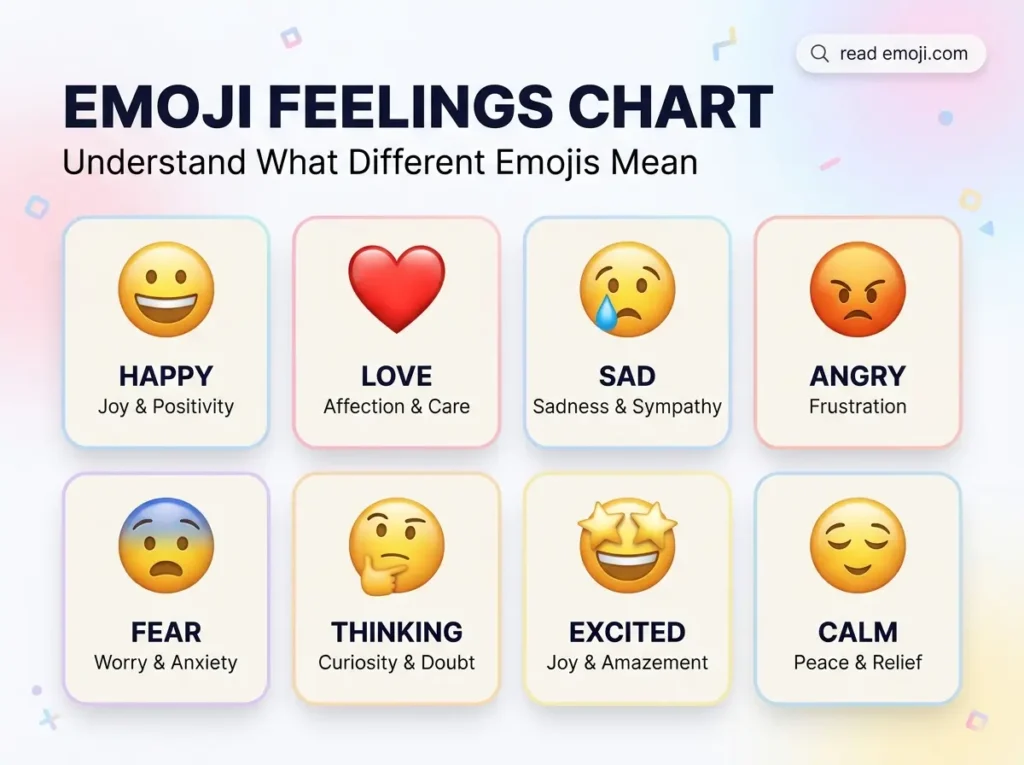
An 😊 Emoji Feelings Chart helps you understand emotions through expressive emojis, from happiness 😄 and love 🥰 to sadness 😢, anger 😡, and fear 😨. It makes recognizing, expressing, and communicating feelings easier and more fun in everyday conversations.
A single emoji can communicate happiness, sadness, excitement, love, frustration, or even a feeling that’s difficult to explain in words. But with hundreds of emojis available, figuring out which one best expresses a particular emotion isn’t always easy. That’s where an emoji feelings chart comes in handy.
An emoji feelings chart organizes emojis by the emotions they commonly represent, helping you quickly find the right symbol for your mood, message, or social media post. Whether you’re sending a happy face to a friend, using a heart to show affection, or choosing a sad face to express disappointment, the right emoji can make your message feel more personal.
However, emojis don’t always communicate exactly what their pictures suggest. A smiling face can express genuine happiness, politeness, embarrassment, or sarcasm, depending on the conversation. Similarly, a heart emoji can represent romantic love, friendship, gratitude, or support.
This guide provides an easy-to-use emoji feelings chart, explains the emotions behind popular emojis, and shows you how to choose the right emoji for texting, social media, friendships, family conversations, and romantic relationships.
Emoji Feelings Chart – Quick Answer
An emoji feelings chart is a visual or text-based guide that groups emojis according to the emotions they commonly express, such as happiness, sadness, love, anger, surprise, fear, and excitement.
Here’s a quick reference chart to help you find an emoji for your feelings.
| Feeling or Emotion | Emoji | Common Meaning |
|---|---|---|
| Happiness | 😀 | Joy, happiness, and positivity |
| Excitement | 🤩 | Enthusiasm, amazement, and excitement |
| Love | ❤️ | Love, affection, and deep care |
| Friendship | 🫶 | Support, connection, and affection |
| Sadness | 😢 | Sadness, disappointment, or sympathy |
| Crying | 😭 | Intense sadness, overwhelming emotion, or laughter |
| Anger | 😠 | Frustration, annoyance, or anger |
| Fear | 😨 | Worry, fear, or shock |
| Surprise | 😮 | Astonishment or unexpected news |
| Embarrassment | 😳 | Awkwardness, shyness, or feeling exposed |
| Nervousness | 😬 | Anxiety, tension, or discomfort |
| Relief | 😮💨 | Relief, exhaustion, or a heavy sigh |
| Confusion | 😕 | Uncertainty or puzzlement |
| Thinking | 🤔 | Thoughtfulness, doubt, or curiosity |
| Playfulness | 😜 | Teasing, joking, or silliness |
| Gratitude | 🙏 | Thanks, appreciation, or a request |
| Hope | 🥹 | Being touched, emotional gratitude, or hopeful feelings |
| Calmness | 😌 | Peace, contentment, or relief |
| Mischief | 😏 | Smugness, teasing, or suggestiveness |
| Boredom | 😑 | Unimpressed feelings or exasperation |
| Disgust | 🤢 | Nausea, revulsion, or strong dislike |
| Sleepiness | 😴 | Tiredness or a desire to sleep |
| Confidence | 😎 | Coolness, confidence, or relaxed positivity |
| Celebration | 🥳 | Parties, achievements, and happy occasions |
| Awkwardness | 🫣 | Nervous curiosity or watching something embarrassing |
Remember: These are common interpretations, not fixed definitions. The surrounding words, relationship, and sender’s communication style can change what an emoji means.
What Does an Emoji Feelings Chart Mean?
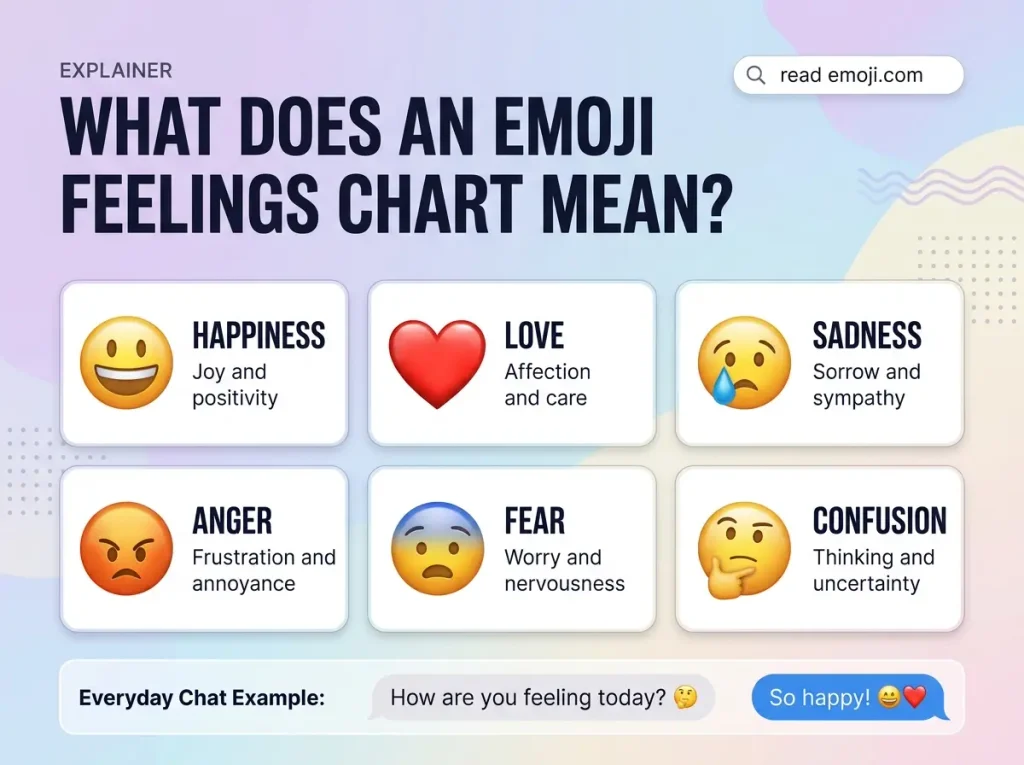
An emoji feelings chart is a simple reference that connects commonly used emojis with emotions, moods, and social expressions.
Instead of searching through hundreds of symbols, you can look for the feeling you want to communicate and choose an appropriate emoji.
For example, if you’re happy about a friend’s achievement, you might use 🥳 or 🤩. If someone shares disappointing news, 😢 or 💔 might communicate sympathy or sadness.
Emoji feelings charts are useful for several reasons:
- Quick communication: Find an emoji that matches your feelings without searching through an entire keyboard.
- Better emotional expression: Add warmth, excitement, sympathy, or humor to text messages.
- Clearer context: Help readers understand the intended tone of a short message.
- Social media engagement: Choose suitable emojis for captions, comments, and replies.
- Emotional learning: Explore how different facial expressions and symbols are commonly used to communicate feelings.
An emoji is not a perfect representation of someone’s emotional state. People sometimes use emojis ironically, exaggerate their reactions for humor, or choose a symbol simply because they like its appearance.
The most useful way to read an emoji is to consider the whole message rather than interpreting the symbol alone.
Emoji Feelings Chart by Emotion
The easiest way to use an emoji feelings chart is to browse by emotional category. The following sections explain common emojis, their typical meanings, and situations where they may be appropriate.
1. Happy Emojis
Happy emojis communicate positive feelings, enjoyment, friendliness, and satisfaction.
| Emoji | Emoji Name | Feeling |
|---|---|---|
| 😀 | Grinning Face | Happiness and friendliness |
| 😃 | Grinning Face with Big Eyes | Cheerfulness and excitement |
| 😄 | Grinning Face with Smiling Eyes | Genuine happiness or amusement |
| 😊 | Smiling Face with Smiling Eyes | Warmth, appreciation, or shyness |
| 😁 | Beaming Face with Smiling Eyes | Excitement or a big smile |
| 🙂 | Slightly Smiling Face | Mild happiness or politeness |
| 😆 | Grinning Squinting Face | Laughter and amusement |
| 😇 | Smiling Face with Halo | Innocence, kindness, or playful goodness |
| 🥰 | Smiling Face with Hearts | Affection and feeling loved |
| 😌 | Relieved Face | Contentment and peace |
When to use happy emojis:
- Responding to good news.
- Thanking someone for a thoughtful gesture.
- Sharing a pleasant experience.
- Making a friendly message feel warmer.
- Expressing happiness about a personal achievement.
Example:
Emily: “I got the job! They called me this morning.”
Sarah: “That’s amazing!! 😄🥳”
Meaning: Sarah is expressing happiness and excitement about Emily’s success.
2. Love and Affection Emojis
Love emojis express affection, emotional connection, gratitude, and romantic interest. However, not every heart or affectionate face has the same tone.
| Emoji | Emoji Name | Common Feeling |
|---|---|---|
| ❤️ | Red Heart | Love and deep affection |
| 🩷 | Pink Heart | Sweetness and affectionate warmth |
| 🧡 | Orange Heart | Warmth, care, and support |
| 💛 | Yellow Heart | Happiness, friendship, and affection |
| 💚 | Green Heart | Nature, support, or personal associations |
| 💙 | Blue Heart | Trust, loyalty, and support |
| 💜 | Purple Heart | Affection, admiration, or personal symbolism |
| 🤍 | White Heart | Gentle affection, peace, or remembrance |
| 🖤 | Black Heart | Dark humor, sadness, or alternative aesthetics |
| 🤎 | Brown Heart | Warmth, connection, or personal associations |
| 💕 | Two Hearts | Mutual affection or sweetness |
| 💗 | Growing Heart | Growing affection or emotional warmth |
| 💖 | Sparkling Heart | Excitement and enthusiastic affection |
| 💓 | Beating Heart | Emotional excitement or affection |
| 💘 | Heart with Arrow | Falling in love or romantic attraction |
| 🥰 | Smiling Face with Hearts | Feeling loved or affectionate |
When to use love emojis:
- Expressing affection toward a partner.
- Showing appreciation for family members.
- Sending a supportive message to a friend.
- Reacting to a thoughtful gesture.
- Celebrating an anniversary or relationship milestone.
Example:
Emily: “Thank you for being there for me yesterday.”
James: “Always. You’ve got me ❤️”
Meaning: The red heart reinforces James’s message of care and emotional support. Whether the exchange is romantic or platonic depends on their relationship.
3. Sad Emojis
Sad emojis communicate disappointment, grief, sympathy, loneliness, or emotional pain.
| Emoji | Emoji Name | Common Feeling |
|---|---|---|
| 🙁 | Slightly Frowning Face | Disappointment or mild sadness |
| ☹️ | Frowning Face | Unhappiness or concern |
| 😔 | Pensive Face | Thoughtfulness or sadness |
| 😞 | Disappointed Face | Disappointment or discouragement |
| 😢 | Crying Face | Sadness or sympathy |
| 😭 | Loudly Crying Face | Intense emotion or dramatic crying |
| 💔 | Broken Heart | Heartbreak or emotional pain |
| 🥺 | Pleading Face | Vulnerability or a request for sympathy |
| 😿 | Crying Cat | Sadness expressed through a cat face |
When to use sad emojis:
- Expressing disappointment about a canceled plan.
- Showing sympathy when someone is upset.
- Sharing an emotional experience.
- Reacting to sad news.
- Communicating that something hurt your feelings.
Example:
Michael: “I can’t make it to your birthday dinner tonight. I’m really sorry.”
David: “Aw, that’s disappointing 😔 We’ll catch up soon.”
Meaning: David expresses disappointment without suggesting that the friendship is in trouble.
Important distinction: 😭 can mean intense sadness, but many people also use it to express uncontrollable laughter, excitement, or emotional overwhelm. The message determines which interpretation makes sense.
4. Angry Emojis
Angry emojis express irritation, frustration, resentment, or strong displeasure.
| Emoji | Emoji Name | Common Feeling |
|---|---|---|
| 😠 | Angry Face | Anger or displeasure |
| 😡 | Pouting Face | Strong anger or outrage |
| 🤬 | Face with Symbols on Mouth | Profanity or intense frustration |
| 😤 | Face with Steam From Nose | Frustration, determination, or pride |
| 🙄 | Face with Rolling Eyes | Annoyance or sarcasm |
| 😒 | Unamused Face | Displeasure or skepticism |
| 😑 | Expressionless Face | Exasperation or unimpressed feelings |
When to use angry emojis:
- Reacting to a frustrating situation.
- Expressing playful annoyance with someone you know well.
- Showing disbelief about an unfair outcome.
- Emphasizing frustration in an informal conversation.
Example:
Emily: “The website crashed right before I submitted my assignment.”
Olivia: “No way 😤 That’s so frustrating!”
Meaning: Olivia shares Emily’s frustration and emphasizes how annoying the situation is.
Use angry emojis carefully in serious conversations. A symbol such as 😡 can make a message seem more confrontational than intended.
5. Fear and Anxiety Emojis
These emojis can communicate worry, nervousness, fear, tension, or discomfort.
| Emoji | Emoji Name | Common Feeling |
|---|---|---|
| 😨 | Fearful Face | Fear, worry, or shock |
| 😱 | Face Screaming in Fear | Terror, shock, or dramatic surprise |
| 😰 | Anxious Face with Sweat | Stress or nervousness |
| 😟 | Worried Face | Concern or anxiety |
| 😬 | Grimacing Face | Awkwardness or tension |
| 🫨 | Shaking Face | Shock, disbelief, or intense disturbance |
| 🫣 | Face with Peeking Eye | Nervous curiosity or apprehension |
When to use fear and anxiety emojis:
- Talking about an upcoming exam.
- Reacting to an unexpected problem.
- Expressing nervousness before a presentation.
- Responding to a frightening scene.
- Describing an awkward or uncomfortable moment.
Example:
Noah: “My final exam starts in ten minutes.”
Ethan: “Good luck! You’ve studied hard 😬”
Meaning: The grimacing face communicates nervous tension, although the encouraging words show support.
6. Surprise and Shock Emojis
Surprise emojis help express astonishment, disbelief, amazement, or an unexpected reaction.
| Emoji | Emoji Name | Common Feeling |
|---|---|---|
| 😮 | Face with Open Mouth | Surprise or realization |
| 😯 | Hushed Face | Astonishment or speechlessness |
| 😲 | Astonished Face | Strong surprise |
| 😱 | Face Screaming in Fear | Shock or dramatic astonishment |
| 🤯 | Exploding Head | Amazement or mental overload |
| 🫢 | Face with Open Eyes and Hand Over Mouth | Shock or surprise |
| 😳 | Flushed Face | Embarrassment or astonishment |
Example:
Olivia: “I just found out we’re going to New York this weekend!”
Emma: “WHAT?! 😲”
Meaning: Emma uses the astonished face to emphasize her surprise.
Surprise emojis can be positive or negative. For example, 🤯 might express amazement at an impressive achievement or disbelief about an unexpected situation.
7. Confused and Thinking Emojis
Thinking emojis communicate curiosity, doubt, uncertainty, reflection, or a need for clarification.
| Emoji | Emoji Name | Common Feeling |
|---|---|---|
| 🤔 | Thinking Face | Thinking or questioning |
| 😕 | Confused Face | Uncertainty or confusion |
| 😵💫 | Face with Spiral Eyes | Dizziness or confusion |
| 🧐 | Face with Monocle | Scrutiny or careful examination |
| 🤨 | Face with Raised Eyebrow | Skepticism or suspicion |
| 😶 | Face Without Mouth | Speechlessness or silence |
| 🤷 | Person Shrugging | Uncertainty or not knowing |
When to use thinking emojis:
- Asking someone to explain something.
- Considering an idea.
- Expressing doubt about a claim.
- Responding to an unexpected statement.
- Showing that you need more information.
Example:
James: “The meeting has moved to a different room, but nobody told us where.”
Daniel: “🤔 Maybe check the calendar invitation?”
Meaning: James’s friend suggests thinking through the problem and finding a practical solution.
8. Embarrassment and Awkwardness Emojis
Some emojis communicate discomfort, shyness, embarrassment, or uncertainty about how to react.
| Emoji | Emoji Name | Common Feeling |
|---|---|---|
| 😳 | Flushed Face | Embarrassment or surprise |
| 🫣 | Face with Peeking Eye | Nervous curiosity |
| 😬 | Grimacing Face | Awkwardness or tension |
| 🫠 | Melting Face | Embarrassment, exhaustion, or overwhelm |
| 🥹 | Face Holding Back Tears | Being touched or emotionally moved |
| 😅 | Grinning Face with Sweat | Nervous laughter or relief |
| 🙈 | See-No-Evil Monkey | Playful embarrassment or not wanting to see something |
Example:
Emily: “I accidentally waved at someone who wasn’t waving at me.”
Sarah: “STOP 😭🙈”
Meaning: Sarah finds the situation funny and is reacting with playful embarrassment on Emily’s behalf.
9. Excitement and Celebration Emojis
Excitement emojis communicate enthusiasm, anticipation, achievement, or a desire to celebrate.
| Emoji | Emoji Name | Common Feeling |
|---|---|---|
| 🤩 | Star-Struck | Amazement and excitement |
| 🥳 | Partying Face | Celebration and happiness |
| 🎉 | Party Popper | Achievement or celebration |
| 🙌 | Raising Hands | Celebration or appreciation |
| 🔥 | Fire | Excitement, excellence, or something impressive |
| 🚀 | Rocket | Progress, ambition, or rapid growth |
| 💯 | Hundred Points | Approval, excellence, or agreement |
| 😍 | Smiling Face with Heart-Eyes | Admiration or enthusiasm |
Example:
Michael: “Our team won the championship!”
Chris: “LET’S GO!! 🥳🎉”
Meaning: Chris celebrates the team’s achievement with enthusiasm.
10. Calmness, Relief, and Comfort Emojis
Not every emotion is intense. Some emojis communicate peace, relief, relaxation, or a sense of comfort.
| Emoji | Emoji Name | Common Feeling |
|---|---|---|
| 😌 | Relieved Face | Calmness or contentment |
| 😮💨 | Face Exhaling | Relief, exhaustion, or frustration |
| 🥱 | Yawning Face | Tiredness or boredom |
| 😴 | Sleeping Face | Sleepiness or rest |
| 🫶 | Heart Hands | Affection, support, or appreciation |
| 🤗 | Hugging Face | Warmth, comfort, or affection |
| ☺️ | Smiling Face | Gentle happiness or warmth |
Example:
Olivia: “The doctor said everything looks fine.”
Emma: “Oh, that’s such a relief 😮💨❤️”
Meaning: Emma communicates relief and care.
What Do Emojis Mean in Texting and Chat?
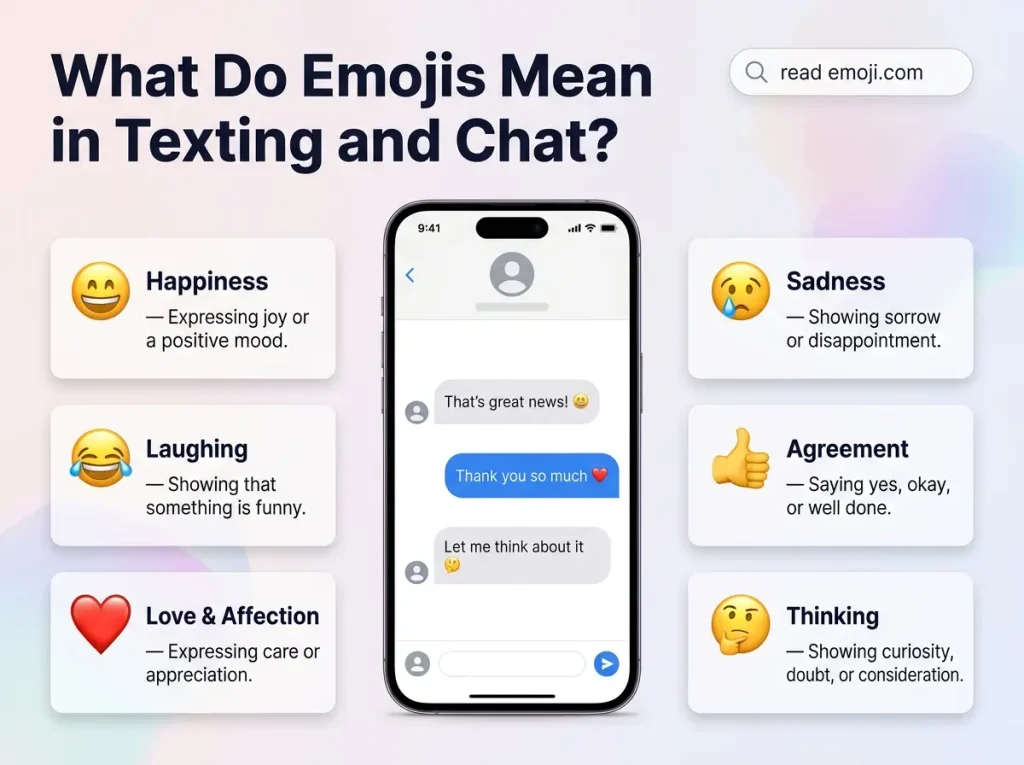
In texting, emojis often act like facial expressions or gestures. They can clarify the tone of a short message, make a response friendlier, or show how someone feels about what they have read.
Here are common ways people use emotion emojis in digital conversations.
Happiness and friendliness
Example:
Emily: “Thanks for helping me move this weekend!”
Jessica: “Of course! 😊”
The smiling face makes the reply sound warm and friendly.
Sarcasm and playful annoyance
Example:
Daniel: “You’re only five minutes late this time 🙄”
Michael: “I’m improving!”
The eye-roll suggests playful annoyance or sarcasm. Depending on their relationship, it might be teasing rather than genuine anger.
Romantic affection
Example:
Emma: “I had such a good time with you tonight ❤️”
Noah: “Me too 🥰”
The emojis reinforce affection, but the relationship and surrounding messages determine how romantic the exchange is.
Sympathy and emotional support
Example:
Sarah: “I’ve had a really difficult day.”
Emily: “I’m sorry. I’m here if you want to talk ❤️”
The heart expresses care and support.
Surprise and disbelief
Example:
James: “They announced a surprise day off tomorrow!”
Chris: “Wait, seriously?! 🤯”
The exploding-head emoji conveys astonishment.
On WhatsApp, iMessage, Messenger, and other chat platforms, the same emoji may appear slightly different depending on the device or operating system. Its general interpretation usually remains recognizable, but its visual design can influence how a message feels.
What Do Emoji Feelings Mean From a Girl?
When a girl sends an emotion emoji, its meaning depends on the conversation, her relationship with the recipient, and her usual communication style.
A smile might be friendly, affectionate, polite, or playful. A heart might show appreciation or romantic interest, but it can also be a completely platonic expression.
| Emoji | Possible Interpretation |
|---|---|
| 😊 | Friendliness, warmth, or happiness |
| 🥰 | Affection or feeling touched |
| ❤️ | Love, care, or strong appreciation |
| 🥹 | Emotional gratitude or being moved |
| 😏 | Teasing, confidence, or flirtation |
| 😭 | Sadness, laughter, or emotional overwhelm |
| 🙄 | Playful annoyance or genuine frustration |
Example:
Olivia: “You remembered my favorite coffee order 🥹”
Ethan: “Of course I did!”
Meaning: Olivia may feel touched or appreciated. The emoji alone does not establish romantic interest.
Look at the entire interaction. Does she initiate conversations, show interest in your life, and communicate consistently? Those behaviors provide more context than a single emoji.
What Do Emoji Feelings Mean From a Guy?
Guys use emojis in many of the same ways as anyone else. An emoji can communicate humor, attraction, appreciation, embarrassment, sadness, or support.
The meaning depends on the person rather than a universal rule about gender.
| Emoji | Possible Interpretation |
|---|---|
| 😎 | Confidence, enthusiasm, or casual friendliness |
| 😂 | Laughter or amusement |
| ❤️ | Affection, love, or appreciation |
| 🥹 | Being touched or emotionally moved |
| 😬 | Nervousness or awkwardness |
| 😏 | Teasing, flirtation, or smugness |
| 🤝 | Agreement, cooperation, or respect |
Example:
Emily: “You actually finished the whole project early!”
James: “Had to deliver 😎”
Meaning: James uses the sunglasses face to communicate confidence or playful pride.
If a guy sends a heart or blushing face, it may be affectionate or flirtatious, but it is not proof of romantic feelings. His words, behavior, and relationship with the recipient matter more.
What Do Emoji Feelings Mean Between Friends?
Friends often use emojis to show encouragement, share jokes, celebrate achievements, or express sympathy.
Some emojis become part of a friendship’s personal language. For example, two friends might use 💀 whenever something is hilarious, even though the skull traditionally represents death.
Common friendship emojis include:
- 😂 for laughter.
- 💛 for warmth and friendship.
- 🫶 for support and appreciation.
- 🥳 for celebrating achievements.
- 😭 for dramatic reactions or laughter.
- 🤗 for comfort and affection.
- 🤝 for agreement or teamwork.
Example:
Michael: “I passed my driving test!”
Daniel: “LET’S GOOO 🥳🙌”
Meaning: Daniel celebrates his friend’s achievement.
A heart emoji between friends does not automatically indicate romantic attraction. Close friends often express love and appreciation without romantic intentions.
What Do Emoji Feelings Mean in a Romantic Relationship?
Couples frequently use emojis to express affection, excitement, reassurance, playfulness, and emotional closeness.
For example:
- ❤️ can communicate love and commitment.
- 🥰 can express tenderness or feeling loved.
- 😘 can suggest a kiss or affectionate goodbye.
- 💕 can express sweetness and mutual affection.
- 💗 can suggest growing affection.
- 🥹 can communicate being deeply touched.
- 🫶 can express appreciation and connection.
Example:
Emma: “I can’t wait to see you this weekend 🥹❤️”
Noah: “Same here. Counting down the days 🥰”
Meaning: The messages communicate anticipation, affection, and emotional closeness.
However, emojis can also help couples soften difficult conversations. A reassuring smile or heart might communicate warmth after an apology.
They cannot replace a meaningful conversation when something serious needs to be discussed. If a message feels unclear, asking the other person what they mean is more reliable than trying to decode every symbol.
What Do Emoji Feelings Mean Between Family Members?
Family members use emojis to express love, encouragement, gratitude, humor, and concern.
Parents might send a heart to show affection, while siblings might use laughing faces to tease each other.
| Emoji | Common Family Use |
|---|---|
| ❤️ | Love and care |
| 🥰 | Affection and warmth |
| 🤗 | Comfort or a virtual hug |
| 🙏 | Gratitude, hope, or a request |
| 🎉 | Celebrating achievements |
| 🥹 | Feeling proud or emotionally touched |
| 😊 | Friendliness and reassurance |
Example:
Mom: “Your brother told me you got promoted!”
Alex: “I did! 😊”
Mom: “We’re so proud of you ❤️”
Meaning: The smile communicates happiness, while the heart expresses family love and pride.
How Are Emoji Feelings Used on Social Media?
Emoji meanings can shift slightly depending on the platform, the type of post, and online trends. Here is how people commonly use emotion emojis across different social media settings.
On Instagram, emojis help communicate reactions to photos, Reels, Stories, and captions.
- 😍 can show admiration for a photo.
- 🔥 can mean something looks impressive or stylish.
- ❤️ can express affection or appreciation.
- 🥹 can show that a post feels touching.
- 😂 can indicate that a Reel is funny.
Example: “This outfit is everything 😍🔥”
The emojis communicate admiration and enthusiasm.
TikTok
TikTok comments often use emojis to react dramatically to jokes, emotional stories, unexpected moments, and relatable videos.
For example, 😭 may mean that something is extremely funny rather than genuinely sad. 💀 can also express laughter or disbelief.
Example: “The ending took me OUT 😭💀”
The commenter is probably describing an overwhelming comedic reaction.
Snapchat
On Snapchat, emojis can appear in messages, captions, and other parts of the interface. Some Snapchat interface symbols also have platform-specific meanings.
A heart in a direct message generally communicates affection or appreciation, but a platform’s friendship indicators may have separate meanings defined by Snapchat.
Do not assume that every emoji shown in an app interface has the same interpretation as an emoji typed into a message.
Facebook users commonly use emojis to react to personal updates, family photos, celebrations, and emotional posts.
For example, ❤️ might communicate sympathy or appreciation, while 😢 can show sadness about disappointing news.
The post’s subject matters. A heart reaction on a memorial post may communicate sympathy rather than romance.
WhatsApp and iMessage
These messaging apps are often used for personal conversations with friends, family members, and partners.
Emojis help people convey warmth, humor, affection, and emotional nuance without writing long explanations.
For example, “Made it home safely 😊” sounds reassuring and friendly, while “Made it home safely 😭” might suggest an emotional or dramatic experience.
The surrounding conversation helps establish the intended meaning.
Real Conversation Examples: How to Interpret Emoji Feelings
The following conversations show how the same or similar emojis can communicate different emotions in everyday situations.
Example 1: Friendship
Emily: “I got tickets for the concert!”
Sarah: “NO WAY 😭🎉”
Meaning: Sarah is excited and may be expressing happy disbelief. The crying face is being used dramatically rather than indicating sadness.
Example 2: Romantic Conversation
Olivia: “I had a wonderful time with you tonight ❤️”
James: “I did too. Let’s do it again soon 🥰”
Meaning: The heart and smiling face with hearts reinforce affection. The messages suggest warmth, but the broader relationship determines whether the exchange is romantic.
Example 3: Family Support
Mom: “I know your interview is tomorrow. You’ve got this! ❤️”
Alex: “Thanks, Mom. I’m nervous 😬”
Meaning: The heart expresses encouragement, while the grimacing face communicates nervousness.
Example 4: Appreciation
Daniel: “Thanks for helping me move all those boxes.”
Michael: “Anytime, man 🤝”
Meaning: The handshake communicates goodwill, cooperation, and friendship.
Example 5: Emotional Support
Sarah: “Today has been rough. I don’t even know what to do.”
Emily: “I’m here for you 🫶”
Meaning: The heart-hands emoji communicates care and support. The message offers emotional reassurance.
Example 6: Social Media
Emma: “Finally finished my first marathon! 🏃♀️”
Olivia: “YOU DID IT!! 🥳💯”
Meaning: Olivia celebrates Emma’s achievement and expresses strong approval.
Example 7: Casual Texting
James: “I forgot my umbrella, and now it’s pouring.”
Chris: “Classic 😭”
Meaning: Chris is probably reacting with playful sympathy or finding the situation funny. The context makes the interpretation clearer.
Emoji Feelings Chart: Differences Between Similar Emojis
Some emojis look similar or express related emotions, but they can create different tones.
Understanding these distinctions can help you choose an emoji that better matches your intended message.
| Emoji | Name | Common Meaning | Typical Tone |
|---|---|---|---|
| 😀 | Grinning Face | Happiness | Cheerful |
| 😊 | Smiling Face with Smiling Eyes | Warmth or appreciation | Gentle and friendly |
| 🙂 | Slightly Smiling Face | Mild positivity or politeness | Subtle; sometimes ambiguous |
| 😍 | Smiling Face with Heart-Eyes | Admiration or love | Enthusiastic |
| 🥰 | Smiling Face with Hearts | Affection or feeling loved | Tender |
| 😘 | Face Blowing a Kiss | Affection or a kiss | Intimate or playful |
| 😢 | Crying Face | Sadness or sympathy | Sad |
| 😭 | Loudly Crying Face | Intense sadness or dramatic emotion | Strong or exaggerated |
| 😠 | Angry Face | Anger or displeasure | Confrontational |
| 🙄 | Face with Rolling Eyes | Annoyance or sarcasm | Dismissive or teasing |
| 😮 | Face with Open Mouth | Surprise or realization | Astonished |
| 🤯 | Exploding Head | Amazement or mental overload | Dramatic |
| 😬 | Grimacing Face | Awkwardness or tension | Uncomfortable |
| 😅 | Grinning Face with Sweat | Nervous laughter or relief | Awkward but friendly |
😊 vs. 🙂
Both emojis have smiles, but their tone can differ.
- 😊 often feels warm, sincere, or appreciative.
- 🙂 can communicate mild happiness or politeness. In some conversations, it may also sound restrained or passive-aggressive.
For example, “Thanks for helping me 😊” usually feels warm, while “Okay 🙂” could sound neutral, polite, or slightly tense depending on the conversation.
😢 vs. 😭
Both emojis can express sadness, but 😭 typically represents a more intense reaction.
- 😢 often communicates sadness, disappointment, or sympathy.
- 😭 can communicate overwhelming sadness, dramatic excitement, or uncontrollable laughter.
For example, “I miss my dog 😢” sounds genuinely sad, while “That video is too funny 😭” uses crying to exaggerate laughter.
❤️ vs. 💕 vs. 🫶
These symbols can all express affection, but they emphasize different things.
- ❤️ Red Heart: Love, care, or strong affection.
- 💕 Two Hearts: Sweetness, closeness, or mutual affection.
- 🫶 Heart Hands: Support, appreciation, or a gesture of love.
A person might use ❤️ to thank a partner, 💕 in a sweet message to a friend, or 🫶 to show appreciation for someone’s support.
None has an exclusive meaning tied to a particular relationship.
Official Emoji Names and Unicode Information
The emojis in a feelings chart are individual characters or sequences recognized within the Unicode standard. Unicode provides the technical framework that allows supported devices and applications to exchange text and emoji characters.
Some important distinctions:
- Emoji names: Unicode assigns names such as “Grinning Face,” “Crying Face,” and “Red Heart.”
- Emoji sequences: Certain emojis combine multiple Unicode characters, such as a person emoji with a skin-tone modifier or a family sequence.
- Platform appearance: Apple, Google, Microsoft, and other vendors may render the same emoji differently.
- Emoji interpretation: The official name describes the character; it does not establish every emotional meaning people assign to it.
- Changing usage: Popular interpretations can evolve as communities develop new slang and online habits.
For example, the official name “Loudly Crying Face” describes 😭, but users may also employ it to express laughter or excitement.
Similarly, the “Skull” emoji 💀 is not simply an expression of death in everyday internet conversations. It is frequently used as slang for laughing extremely hard or being overwhelmed by something funny.
For technical details, consult the official Unicode Emoji Charts and Unicode Emoji documentation. These resources help distinguish official character information from informal interpretations.
Common Mistakes When Using an Emoji Feelings Chart
An emoji chart is helpful, but relying on it too literally can lead to misunderstandings.
1. Assuming Every Emoji Has One Meaning
A crying face may communicate sadness, laughter, frustration, or excitement. Context determines which interpretation is most plausible.
2. Assuming a Heart Always Means Romantic Love
Friends, parents, siblings, coworkers, and acquaintances may all use hearts to communicate different kinds of care or appreciation.
3. Ignoring the Words Around the Emoji
Compare these messages:
- “I’m so happy for you 😭”
- “I can’t believe you did that 😭”
The same emoji may communicate happy overwhelm in the first message and disbelief or frustration in the second.
4. Assuming Gender Determines the Meaning
A girl or guy can use the same emoji for the same reason. Gender alone is not a reliable way to interpret someone’s intentions.
5. Confusing Similar Facial Expressions
😊, 🙂, 😌, and 😍 all have positive associations, but they communicate different tones. Choosing one that fits the message can make your meaning clearer.
6. Treating Internet Slang as Universal
Emojis such as 💀 and 😭 can represent laughter in online communities. However, not everyone uses or understands this slang in the same way.
7. Using Emojis Instead of Clarifying Serious Messages
If someone sends a confusing or emotionally important message, guessing based on one symbol may create unnecessary tension.
A simple question such as “What did you mean by that?” is often more helpful than assuming the worst.
When Should You Use Emotion Emojis?
Emotion emojis are useful whenever you want to add emotional context to a message.
Consider using them in the following situations:
To celebrate good news: Use 🥳, 🎉, or 🤩 to congratulate someone.
To show affection: Use ❤️, 🥰, or 🫶 when the relationship and conversation make the warmth appropriate.
To express sympathy: Use 😢, 🥺, or ❤️ when responding to disappointing news or someone’s difficult experience.
To communicate excitement: Use 🤩, 😆, or 🔥 when something impresses you.
To make a friendly message warmer: Use 😊 or ☺️ to communicate friendliness.
To show uncertainty: Use 🤔 or 😕 when you’re thinking through something or need clarification.
To express relief: Use 😮💨 or 😌 after a stressful situation has ended.
To react to humor: Use 😂, 🤣, or sometimes 😭 when something makes you laugh.
The best emoji is the one that matches the tone you want to convey and feels natural for your relationship with the recipient.
When Should You Avoid Using Certain Emojis?
Emojis are common in casual communication, but some situations require more careful wording.
Formal or Professional Messages
A smile or thumbs-up may be perfectly acceptable in a friendly workplace conversation. However, a long string of playful or affectionate emojis might distract from a serious business message.
For formal communication, keep emojis limited unless you know they fit the recipient’s style.
Sensitive Conversations
When someone is grieving, frightened, or dealing with a serious problem, avoid assuming that a laughing or playful emoji will be understood as supportive.
Use clear, compassionate words first.
Unclear Romantic Signals
Heart-eyes, kisses, and affectionate hearts may be interpreted as flirtatious in some conversations. If you want to maintain a clearly professional or platonic tone, choose your emojis accordingly.
Arguments or Disagreements
An eye-roll 🙄 or smirking face 😏 can make a disagreement seem dismissive or sarcastic.
If your intention is to resolve a conflict, straightforward language may work better.
Messages That Need Precision
Emojis should not replace important instructions, deadlines, consent, or other information that needs to be understood clearly.
In these cases, write the essential message in words and use emojis only if they genuinely improve the tone.
Frequently Asked Questions About Emoji Feelings Charts
1. What is an emoji feelings chart?
An emoji feelings chart is a guide that organizes emojis by common emotions, including happiness, sadness, anger, love, surprise, fear, and excitement. It helps people quickly find symbols that match their feelings.
2. Which emoji represents happiness?
😀 and 😄 commonly represent happiness and cheerfulness. 😊 often adds a warmer, gentler tone, while 🥳 is useful for excitement and celebrations.
3. Which emoji represents sadness?
😢 commonly represents sadness, disappointment, or sympathy. 😭 can express intense sadness, although it is also frequently used online for laughter or emotional overwhelm.
4. Which emoji represents love?
❤️ is widely used to represent love and affection. 🥰 often communicates tenderness, while 💕 can express sweetness and closeness. The relationship between the people affects the interpretation.
5. What emoji represents anger?
😠 and 😡 are common choices for anger or displeasure. 😤 can express frustration or determination, while 🙄 often communicates annoyance or sarcasm.
6. What emoji represents confusion?
😕 commonly expresses uncertainty or confusion. 🤔 suggests thinking or questioning, while 🤨 can communicate skepticism or suspicion.
7. What does 😭 mean in texting?
😭 officially represents the Loudly Crying Face. In texting, it can express sadness, intense emotion, uncontrollable laughter, or dramatic disbelief. The surrounding words usually help clarify the intended meaning.
8. What is the difference between 😊 and 🙂?
😊 often communicates warmth, friendliness, or appreciation. 🙂 can express mild happiness or politeness, but in some conversations it may feel restrained or passive-aggressive.
9. Can the same emoji have different meanings?
Yes. The same emoji can communicate different emotions depending on the context, relationship, wording, cultural background, and personal communication style of the sender.
10. Do heart emojis always mean romantic love?
No. Heart emojis can express romantic love, friendship, family affection, gratitude, sympathy, or support. A heart by itself does not prove romantic interest.
11. Which emojis are best for showing support?
❤️, 🫶, 🤗, and 🥹 can communicate care, comfort, and appreciation. Pairing them with supportive words often makes the intended message clearer.
12. Are emoji meanings the same on every platform?
The general meaning is often recognizable across platforms, but visual designs may differ. Online slang and personal habits can also change how people interpret an emoji.
Conclusion
An emoji feelings chart makes it easier to understand the emotions commonly associated with different emojis. From happiness and excitement to sadness, anger, love, and relief, these symbols help people communicate feelings in a quick and familiar way.
The key is to choose an emoji that matches your intended tone. A smiling face can make a message feel friendly, a red heart can express affection, and a thinking face can communicate uncertainty. However, the same symbol may mean something different depending on the words around it and the relationship between the people communicating.
When interpreting someone else’s emoji, consider the full conversation rather than relying on a single symbol. Remember that emojis can be used literally, playfully, sarcastically, or as part of internet slang.
Use this chart as a practical reference when texting friends, talking with family, messaging a partner, or writing social media captions. With a little attention to context, you can choose emojis more confidently and better understand the emotions other people may be trying to express.
RELATED POST:
Silence Emoji Meaning : Best Options and How to Use Them (2027 Meaning & Uses)
Waving Emoji GIF Meaning: Uses and Where to Find the Best Animated Waves (Latest 2027)
Paper Airplane Emoji Meaning: What It Means in Texting and Chat (2027 Quick Guide)

Alex Carter is a writer and content contributor at ReadEmoji.com. He focuses on explaining emoji meanings, common usage, and digital communication in a simple and easy-to-understand way. His goal is to help readers quickly understand what popular emojis mean and how they are commonly used in everyday conversations.