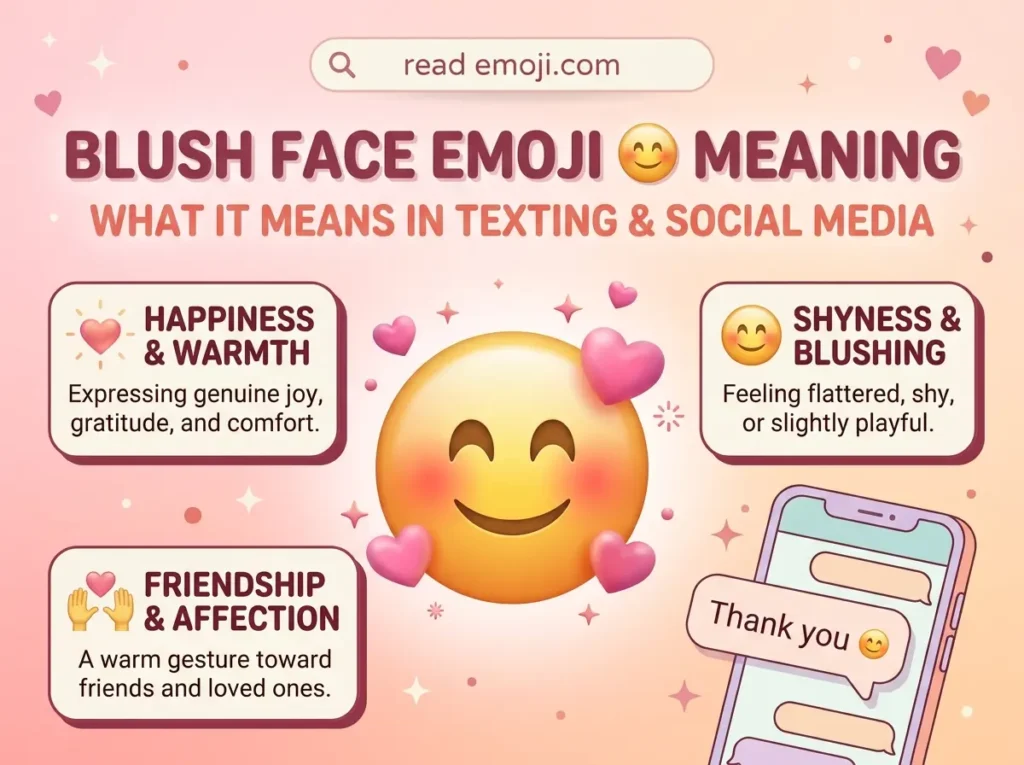
The 😊 Blush Face Emoji represents happiness, warmth, shyness, and sweet affection. Often used in texting and social media, it expresses genuine appreciation, friendly smiles, romantic feelings, or feeling pleasantly embarrassed by a compliment.
The blush face emoji 😊 is a friendly way to express happiness, warmth, appreciation, and gentle affection. In texting, it can make a message feel sweeter, softer, or more personal. Depending on the conversation, it may also suggest shyness, gratitude, friendliness, or subtle romantic interest.
Unlike a laughing emoji, which emphasizes humor, the blush face emoji often communicates a pleasant feeling without making a big deal out of it. Someone might use it to say thank you, respond to a compliment, show appreciation, or make a casual conversation feel more welcoming.
However, the meaning isn’t always romantic. A friend might send 😊 to show kindness, a family member might use it to express affection, and a coworker might add it to a polite message. The surrounding words and your relationship with the sender usually matter more than the emoji alone.
In this guide, you’ll learn what the blush face emoji means, how people use it in text messages and social media, what it might mean when sent by a girl or a guy, and how it differs from similar smiling and heart emojis. You’ll also find realistic conversation examples to help you understand its tone.
Blush Face Emoji 😊 – Quick Answer
The blush face emoji 😊 represents happiness, friendliness, warmth, gratitude, and gentle affection. Its smiling face and rosy cheeks give it a soft, pleasant tone.
People commonly use 😊 to:
- Show happiness or appreciation.
- Respond politely to a compliment.
- Make a message feel warm and friendly.
- Express shyness or mild embarrassment.
- Show affection without using a heart.
- Add a gentle, sometimes flirtatious tone to a conversation.
The key takeaway: 😊 is usually positive, but it doesn’t automatically mean someone is romantically interested. Its meaning depends on the message, the relationship, and the sender’s usual texting style.
What Does the Blush Face Emoji 😊 Mean?
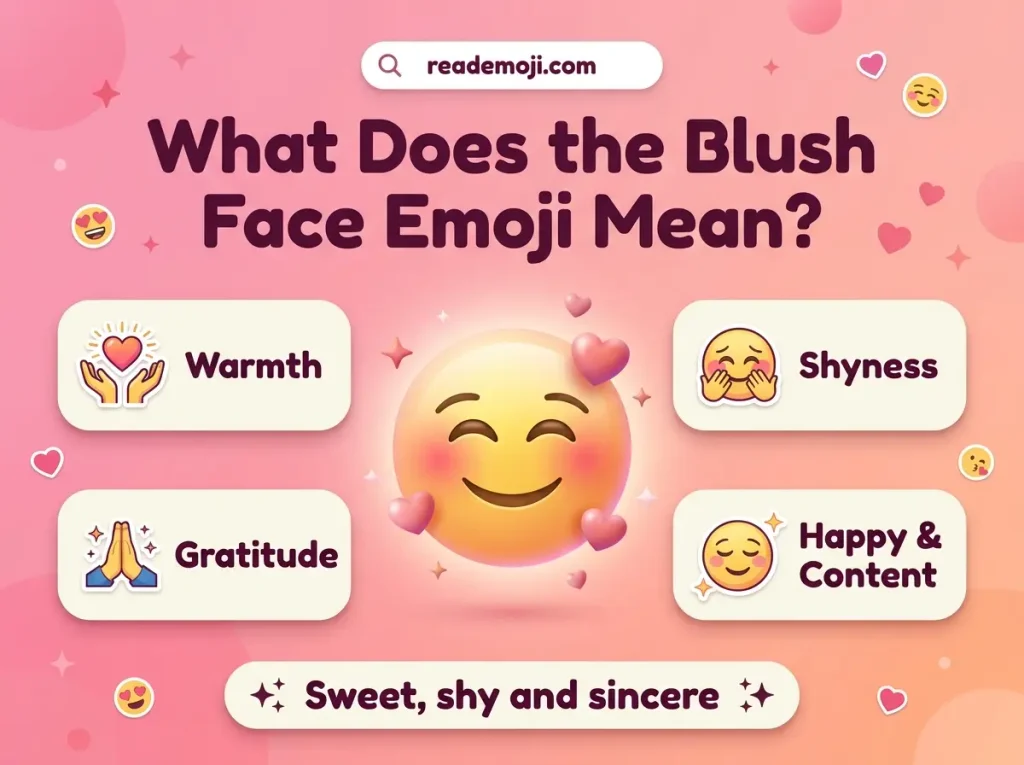
The blush face emoji 😊 has a gentle, closed-mouth smile and smiling eyes. Its rosy cheeks give it a warm, slightly bashful appearance. Although people often call it the blush face emoji, its official Unicode name is “Smiling Face with Smiling Eyes.” Unicode also lists “blush” among its associated keywords.
Unicode Consortium
+1
Here are its most common interpretations.
1. Happiness and Contentment
😊 can express quiet happiness, satisfaction, or a pleasant mood. It is useful when you want to show that something made you feel good without using a dramatic expression.
Example:
“Finally finished my exams 😊”
The sender is probably expressing relief, happiness, or satisfaction.
2. Kindness and Friendliness
The emoji can make a message feel more welcoming. People use it to soften short replies that might otherwise seem cold or overly direct.
Example:
“Sure, I can help you with that 😊”
Here, the smile adds warmth and friendliness.
3. Shyness or Feeling Bashful
The rosy cheeks can suggest that someone feels shy, flattered, or a little embarrassed. This interpretation becomes especially plausible after a compliment or a sweet remark.
Example:
“You looked really nice today.”
“Aw, thank you 😊”
The reply may suggest that the compliment made the person feel good or slightly bashful.
4. Appreciation and Gratitude
😊 is a natural way to say thank you while showing genuine warmth.
Example:
“Thanks for checking in on me 😊”
The emoji adds a personal touch and helps communicate appreciation.
5. Affection or Subtle Flirting
In some conversations, 😊 can carry a hint of affection or romantic interest. It may feel especially meaningful when someone uses it during a personal conversation, after a compliment, or while talking about spending time together.
However, the emoji alone is not proof of attraction. A friendly person may use it with everyone, while another person may reserve it for people they feel close to.
What Does the Blush Face Emoji Mean in Texting and Chat?
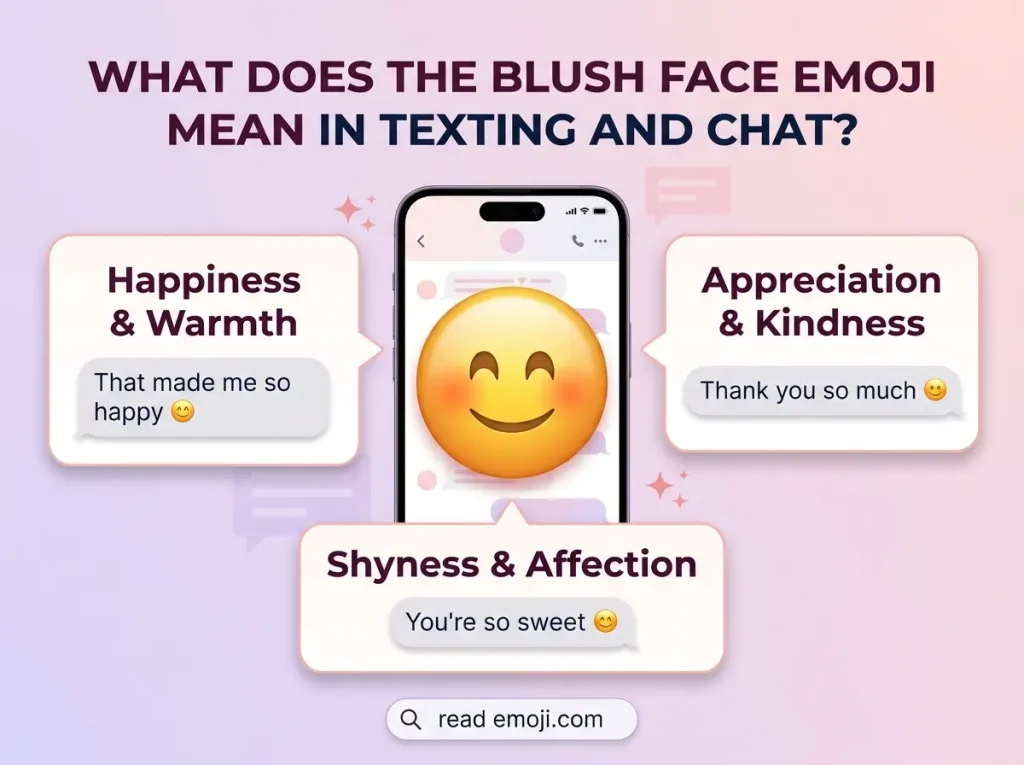
In texting, the blush face emoji often communicates the emotion behind a message rather than adding a completely different meaning. It can turn an ordinary sentence into something warmer, sweeter, or more personal.
Here is how it may be interpreted in common situations.
| Text message | Possible meaning |
|---|---|
| “Thank you 😊” | Appreciation and warmth |
| “That sounds great 😊” | Happiness or agreement |
| “You’re so sweet 😊” | Affection or feeling touched |
| “I had fun with you 😊” | Enjoyment and possibly interest |
| “Good morning 😊” | A friendly or affectionate greeting |
| “I’m glad you’re okay 😊” | Relief and care |
| “You made my day 😊” | Happiness and appreciation |
| “See you tomorrow 😊” | A pleasant, friendly farewell |
On WhatsApp and iMessage
On WhatsApp and iMessage, 😊 commonly appears at the end of everyday messages. Friends may use it to sound cheerful, partners may use it to express affection, and family members may use it to make messages feel loving.
For example:
Emily: “I saved you a piece of cake!”
Sarah: “You’re the best 😊”
Sarah’s reply expresses appreciation and friendliness. It doesn’t necessarily suggest anything romantic.
In Messenger and Online Chats
In Messenger and other online chats, the emoji can help communicate a positive tone when facial expressions and vocal cues are missing.
For instance, “No problem” can sound brief or neutral on its own. Adding 😊 makes the response feel more reassuring.
It can also be used after a joke, a compliment, or an offer of help. The exact meaning still depends on what came before it.
What Does the Blush Face Emoji Mean From a Girl?
When a girl sends 😊, it can suggest friendliness, happiness, appreciation, shyness, or affection. In some situations, it may also be a subtle way to flirt.
The context helps distinguish these possibilities.
- After a compliment: She may feel flattered or pleased.
- After you help her: She may be showing gratitude.
- During a casual conversation: She may simply be friendly.
- After a romantic or playful message: She may be responding warmly or showing interest.
- When saying goodnight: She may want to end the conversation on a sweet note.
For example:
Ryan: “I always enjoy talking to you.”
Olivia: “Aww, that’s really sweet 😊”
Olivia’s response sounds warm and appreciative. It could indicate affection, but it doesn’t establish romantic interest by itself.
If you’re trying to understand her feelings, pay attention to whether she initiates conversations, asks about your life, makes plans with you, and communicates consistently. Those patterns provide more context than a single emoji.
What Does the Blush Face Emoji Mean From a Guy?
When a guy sends 😊, he may be expressing friendliness, gratitude, happiness, or a gentle kind of affection. He might also use it when he feels flattered or wants to make a message sound less serious.
Some common situations include:
- After receiving a compliment: He may feel pleased or shy.
- When thanking you: He may want to sound sincere and friendly.
- During a personal conversation: He may be expressing warmth or emotional closeness.
- After a playful exchange: He may be keeping the mood light.
- While talking about meeting again: He may be showing that he’s happy about the plan.
For example:
Megan: “You always know how to make me laugh.”
Jake: “I’m glad I can 😊”
Jake’s reply sounds warm and considerate. If he regularly shows interest in Megan’s life and makes an effort to spend time with her, the emoji might be part of a broader pattern of affection. On its own, though, it could simply be friendly.
The same principle applies regardless of gender: look at the full conversation rather than assuming a particular intention.
Blush Face Emoji Meaning Between Friends
Among friends, 😊 usually communicates warmth, appreciation, encouragement, and everyday happiness. It is an easy way to make a conversation feel more positive without making it romantic.
Friends might use it when:
- Thanking each other for a favor.
- Celebrating good news.
- Offering emotional support.
- Sharing a happy memory.
- Making plans to hang out.
- Giving a friendly compliment.
Example:
Lauren: “I had such a good time at the concert with you.”
Mia: “Same! We need to do that again 😊”
Mia is expressing enthusiasm and enjoying the friendship. The emoji reinforces the positive tone without implying romantic feelings.
Best friends may also use 😊 alongside hearts, inside jokes, or affectionate nicknames. In those cases, the overall communication style helps determine how personal the message feels.
Blush Face Emoji Meaning in a Romantic Relationship
Between romantic partners, 😊 can express tenderness, appreciation, happiness, and quiet affection. It often works well in everyday conversations where a full romantic declaration would feel unnecessary.
A boyfriend or girlfriend might send it when:
- Saying good morning or goodnight.
- Thanking their partner for being thoughtful.
- Responding to a loving message.
- Talking about a date.
- Expressing happiness about seeing each other.
- Offering comfort after a difficult day.
Example:
Ethan: “I can’t wait to see you this weekend.”
Chloe: “Me neither. I’ve missed you 😊”
Chloe’s message communicates affection and anticipation. The emoji makes the message feel gentle and sweet.
Does 😊 Mean “I Love You”?
Not necessarily. It can accompany loving messages, but it isn’t a direct declaration of love. A person may use it to express general happiness or friendliness.
Compare these examples:
- “Thanks for your help 😊” — likely appreciation.
- “I loved spending time with you 😊” — warmth and affection.
- “I miss you so much 😊❤️” — a more explicitly affectionate message.
When a relationship is already romantic, the emoji may carry more emotional significance because both people share that context.
What Does the Blush Face Emoji Mean Between Family Members?
Family members often use 😊 to show care, encouragement, gratitude, and affection. Parents might send it when checking in on their children, siblings might use it after helping each other, and relatives might include it in greetings.
For example:
Mom: “Let me know when you get home safely 😊”
Alex: “I will, Mom!”
Here, the emoji adds warmth and concern to a practical message.
Another example:
Daniel: “Thanks for helping me move this weekend.”
Jessica: “Of course! That’s what siblings are for 😊”
In family conversations, the emoji generally supports the meaning of the words. It usually doesn’t need a romantic interpretation.
What Does the Blush Face Emoji Mean on Social Media?
The blush face emoji is useful on social media because it can express positive feelings without requiring a long comment. Its meaning may shift slightly depending on whether it appears in a caption, comment, story reply, or direct message.
On Instagram, 😊 can appear in captions, comments, and DMs to convey happiness, appreciation, and friendliness.
For example, commenting “Such a beautiful picture 😊” expresses a positive reaction. Between people who already flirt, the same emoji may feel a little more personal.
TikTok
On TikTok, the emoji can accompany reactions to wholesome videos, personal achievements, funny moments, or uplifting content.
A comment such as “This made me so happy 😊” communicates a warm response rather than intense laughter.
Snapchat
On Snapchat, 😊 may appear in a casual snap, a reply to a compliment, or a conversation between friends. Its significance depends on the message and the relationship, not simply on where it appears.
On Facebook, people may use 😊 in comments on family updates, celebrations, personal milestones, and friendly posts.
For example, “So happy for you and your family 😊” expresses support and goodwill.
WhatsApp Statuses and Stories
In a status or story, 😊 can accompany a positive life update, a photo with friends, or a small personal achievement.
A caption such as “A little moment of happiness 😊” communicates contentment without needing to explain every detail.
Remember that there is no universal social media meaning for this emoji. The caption, image, and surrounding conversation all influence how people interpret it.
Real Conversation Examples of the Blush Face Emoji 😊
These examples show how the same emoji can express different feelings in everyday American English conversations.
1. Between Friends
Ashley: “I got us tickets for the game!”
Megan: “No way! You’re amazing 😊”
Meaning: Megan is excited and appreciative. The emoji adds warmth to her reaction.
2. During a Romantic Conversation
Noah: “I was smiling the whole drive home after our date.”
Emma: “Stop, that’s so cute 😊”
Meaning: Emma may feel flattered or affectionate. The romantic context makes a flirtatious interpretation plausible.
3. Between Family Members
Mom: “I made your favorite dinner for tonight.”
Jake: “You’re the best, Mom 😊”
Meaning: Jake is showing appreciation and affection toward his mother.
4. Offering Support
Rachel: “I finally finished my presentation. I was so nervous.”
Sophie: “I knew you could do it 😊”
Meaning: Sophie is encouraging Rachel and celebrating her accomplishment.
5. Responding to a Compliment
Tyler: “You have a really great sense of humor.”
Madison: “Aw, thank you 😊”
Meaning: Madison may feel pleased or a little bashful after receiving the compliment.
6. In a Social Media Comment
Kevin: “We finally made it to the mountains!”
Brandon: “That view is incredible 😊”
Meaning: Brandon is expressing admiration and a positive reaction to Kevin’s post.
7. Casual Texting
Ava: “I’ll see you at the coffee shop at 10.”
Lily: “Perfect, see you there 😊”
Meaning: Lily is confirming the plan in a friendly, pleasant way.
8. When Someone Says Something Sweet
Daniel: “You always make a bad day better.”
Grace: “I’m happy I can 😊”
Meaning: Grace is responding with warmth. Depending on their relationship, it could reflect friendship or romantic affection.
Blush Face Emoji 😊 vs. Similar Emojis
The blush face emoji is sometimes confused with other smiling faces because several emojis communicate happiness or friendliness. However, their expressions can give messages different tones.

😊 Blush Face Emoji
Official name: Smiling Face with Smiling Eyes
Often expresses warmth, gratitude, happiness, and gentle affection. Its rosy cheeks can suggest shyness or feeling flattered.

🙂 Slightly Smiling Face
Often conveys a mild smile, politeness, or restrained positivity. Depending on the conversation, it can sometimes feel neutral or reserved.

🥰 Smiling Face with Hearts
Expresses stronger affection, adoration, or feeling loved. It makes the emotional tone more explicitly affectionate.

😍 Smiling Face with Heart-Eyes
Often expresses intense admiration, excitement, attraction, or love for someone or something.

😉 Winking Face
Often suggests teasing, playful humor, an inside joke, or flirtation. The wink makes the tone more knowing or mischievous.
Comparison Table
| Emoji | Common meaning | Typical tone |
|---|---|---|
| 😊 | Happiness, warmth, appreciation | Gentle and friendly |
| 🙂 | Mild happiness, politeness | Subtle or reserved |
| 🥰 | Affection, adoration | Loving and tender |
| 😍 | Admiration, attraction | Excited and expressive |
| 😉 | Teasing, playful intent | Cheeky or flirtatious |
| 😁 | Excitement, cheerful happiness | Energetic and upbeat |
| ☺️ | Warmth, contentment, gratitude | Soft and classic |
These are common interpretations, not fixed rules. Different people and platforms may display or use emojis somewhat differently.
Blush Face Emoji 😊 vs. Heart Emojis
The blush face emoji can communicate affection, but it differs from heart emojis because its primary visual message is a smiling facial expression.
| Emoji | Name | Common meaning | Typical tone |
|---|---|---|---|
| 😊 | Smiling Face with Smiling Eyes | Happiness, warmth, gratitude | Friendly and gentle |
| ❤️ | Red Heart | Love, strong affection, support | Direct and heartfelt |
| 🩷 | Pink Heart | Tenderness, caring, affection | Soft and sweet |
| 💕 | Two Hearts | Mutual affection, closeness | Playful and loving |
| 💖 | Sparkling Heart | Excitement, admiration, affection | Bright and enthusiastic |
| 🤍 | White Heart | Care, peace, support | Calm and gentle |
Which Emoji Should You Use?
Choose 😊 when you want to sound warm, happy, or appreciative without making the message explicitly romantic.
Choose ❤️ when you want to communicate love or strong affection more directly.
Choose 🩷 for a soft, affectionate tone, particularly when a pink heart fits the style of your conversation.
Choose 💕 when expressing closeness or shared affection.
Choose 💖 when you want your affection or excitement to feel especially enthusiastic.
For example, “Thank you for being there for me 😊” expresses warmth and gratitude. “Thank you for being there for me ❤️” can communicate a stronger sense of love or emotional closeness.
Neither choice has a guaranteed meaning. Your relationship and usual communication style still matter.
Official Unicode Information About 😊
The blush face emoji has a formal name in the Unicode Standard, even though many people use informal descriptions when searching for it.
| Detail | Information |
|---|---|
| Emoji | 😊 |
| Official Unicode name | Smiling Face with Smiling Eyes |
| Unicode code point | U+1F60A |
| Unicode character category | Emoji character |
| Common associated keyword | Blush |
| Common uses | Smiling, happiness, warmth, appreciation |
The official name and associated keywords are listed in Unicode’s emoji charts.
Unicode Consortium
+1
Why do people call it the blush face emoji?
Its rosy cheeks give it the appearance of someone smiling while blushing. That visual detail makes “blush face emoji” a natural informal search term, particularly when people want to understand whether the sender feels shy, flattered, or affectionate.
The official name is more specific: it describes the smiling eyes rather than naming the emoji after blushing. When searching for the character in an emoji keyboard or reference list, try “smiling face with smiling eyes” as well as “blush.”
Common Mistakes When Interpreting 😊
Even though the blush face emoji is generally positive, its meaning can be misunderstood when people assume that every smile carries the same emotional message.
Mistake 1: Assuming It Always Means Romantic Interest
😊 can accompany flirting, but it is also common in everyday friendly conversations. One emoji is not enough to establish that someone has a crush on you.
Mistake 2: Confusing It With 🥰
The two emojis can both express affection, but 🥰 includes hearts and communicates a more explicitly affectionate visual message. 😊 is often more versatile and suitable for casual interactions.
Mistake 3: Ignoring the Words Around It
“Thanks for your help 😊” usually sounds appreciative. “I can’t stop thinking about you 😊” carries a more personal tone. The same emoji supports different meanings depending on the words.
Mistake 4: Assuming Everyone Uses Emojis the Same Way
Some people add 😊 to almost every friendly message. Others use it sparingly. The sender’s usual habits can make a big difference.
Mistake 5: Treating It as Proof of Someone’s Feelings
A smiling emoji can indicate that a message is pleasant or affectionate, but it cannot tell you everything about another person’s intentions. Look for consistency in their words and actions.
Mistake 6: Assuming It Always Signals Shyness
Although the rosy cheeks can suggest bashfulness, many people use 😊 simply to sound friendly or happy. Shyness is only one possible interpretation.
When Should You Use the Blush Face Emoji?
😊 works best when you want to add warmth to a message without making it overly emotional.
Consider using it in these situations:
- Saying thank you: “Thanks for picking that up for me 😊”
- Responding to good news: “That’s wonderful! I’m so happy for you 😊”
- Giving encouragement: “You’ve got this 😊”
- Responding to a compliment: “That’s really nice of you to say 😊”
- Making plans: “Looking forward to Saturday 😊”
- Greeting someone: “Good morning! Hope you have a great day 😊”
- Showing appreciation: “I really appreciate your help 😊”
- Expressing affection: “I’m glad you’re in my life 😊”
It is particularly useful when a plain text reply might seem too brief. Adding the emoji gives the message a friendly visual cue without requiring a long explanation.
When Should You Avoid Using 😊?
There is no strict rule against using the blush face emoji, but certain situations call for a more careful choice.
In Formal or Serious Workplace Messages
In professional communication, an emoji may be fine in a casual team chat but unnecessary in a formal report, a serious complaint, or a message to someone you do not know well.
For example, “I’ve reviewed the report and will send the revisions by noon” is clear without an emoji. With a familiar coworker, adding 😊 might be perfectly natural, depending on the team’s communication style.
When Someone Is Sharing Difficult News
If someone is telling you about a serious problem, responding with 😊 could unintentionally make your message seem dismissive.
A sincere written response, such as “I’m sorry you’re dealing with that. I’m here if you need anything,” may be more appropriate.
When You Want to Avoid Mixed Signals
If you are speaking to someone who may interpret friendly messages romantically, consider whether the emoji fits the tone you intend to convey. You don’t need to avoid it entirely, but clearer wording can help prevent confusion.
When a Direct Answer Is More Appropriate
In a serious disagreement or important discussion, a smiling emoji may soften your words in a way that makes your meaning less clear. Prioritize a thoughtful response over an emoji when clarity matters.
Frequently Asked Questions About the Blush Face Emoji 😊
1. What does the blush face emoji 😊 mean?
The blush face emoji usually means happiness, friendliness, warmth, gratitude, or gentle affection. It can also suggest shyness or feeling flattered, depending on the conversation.
2. What does 😊 mean in texting?
In texting, 😊 adds a warm, positive tone to a message. People use it to say thank you, respond to compliments, show happiness, or make casual replies feel friendlier.
3. What does 😊 mean from a girl?
A girl may use 😊 to express friendliness, appreciation, happiness, or affection. If it appears after a compliment or flirtatious message, it may suggest she feels flattered, but it doesn’t automatically mean she is romantically interested.
4. What does 😊 mean from a guy?
A guy may use 😊 to communicate warmth, gratitude, happiness, or shyness. In a romantic conversation, it can express affection, but it may simply be his usual way of texting.
5. Does the blush face emoji mean love?
Not necessarily. 😊 can accompany loving messages, but it more broadly expresses warmth and happiness. A heart emoji such as ❤️ communicates love more directly in many contexts.
6. Is 😊 a flirty emoji?
It can be. When used after a compliment, a playful message, or a personal remark, 😊 may create a gentle, flirtatious tone. In ordinary conversation, however, it is often simply friendly.
7. What is the difference between 😊 and 🥰?
😊 is commonly associated with happiness, friendliness, and warmth. 🥰, the Smiling Face with Hearts emoji, more explicitly conveys affection, adoration, or feeling loved.
8. What does 😊 mean between friends?
Between friends, it commonly expresses appreciation, support, happiness, or kindness. It can make a conversation feel more personal without suggesting romance.
9. What does 😊 mean on Instagram?
On Instagram, 😊 may appear in captions, comments, and direct messages to show happiness, appreciation, or friendliness. Its meaning depends on the content and the relationship between the people communicating.
10. What does it mean when someone sends only 😊?
A standalone 😊 generally communicates a positive or friendly reaction. It might mean “I’m happy,” “that’s nice,” or “I appreciate that.” To understand the sender’s intention, consider what you said immediately before the emoji.
11. Is 😊 the same as 🙂?
No. 😊 is officially named Smiling Face with Smiling Eyes and has rosy cheeks. 🙂 is the Slightly Smiling Face emoji. Both can communicate positivity, but 😊 often feels warmer or more expressive, while 🙂 may feel more restrained.
12. What is the official name of the blush face emoji?
The official Unicode name is Smiling Face with Smiling Eyes, and its code point is U+1F60A. “Blush face emoji” is a common informal description rather than its official name.
Unicode Consortium
+1
Conclusion
The blush face emoji 😊 is a simple but versatile way to express happiness, kindness, appreciation, and gentle affection. Its smiling eyes and rosy cheeks give it a warm appearance, making it useful in everything from everyday text messages to heartfelt conversations.
When someone sends you 😊, the most likely interpretation is that they want their message to feel positive, friendly, or pleasant. It can suggest shyness or romantic interest in the right context, particularly after a compliment or a personal exchange, but it does not automatically mean love or attraction.
The surrounding words, your relationship with the sender, and their usual texting habits are the best clues to its meaning. It also helps to distinguish 😊 from emojis such as 🙂, 🥰, and ❤️, which can communicate different levels or kinds of emotion.
Ultimately, use the blush face emoji when you want to make a message feel a little warmer without saying too much. Whether you’re thanking a friend, encouraging a family member, or sharing a sweet moment with a partner, 😊 can communicate a friendly smile in just one character.
RELATED POST:
Action Emoji Meaning: What It Means and How to Use It (Updated 2027)
Copyright Emoji Meaning: What It Means and How to Use It (Complete Guide 2027)
Hot Chocolate Emoji Meaning: What It Means in Texting and Chat (2027 Easy Guide)

Alex Carter is a writer and content contributor at ReadEmoji.com. He focuses on explaining emoji meanings, common usage, and digital communication in a simple and easy-to-understand way. His goal is to help readers quickly understand what popular emojis mean and how they are commonly used in everyday conversations.