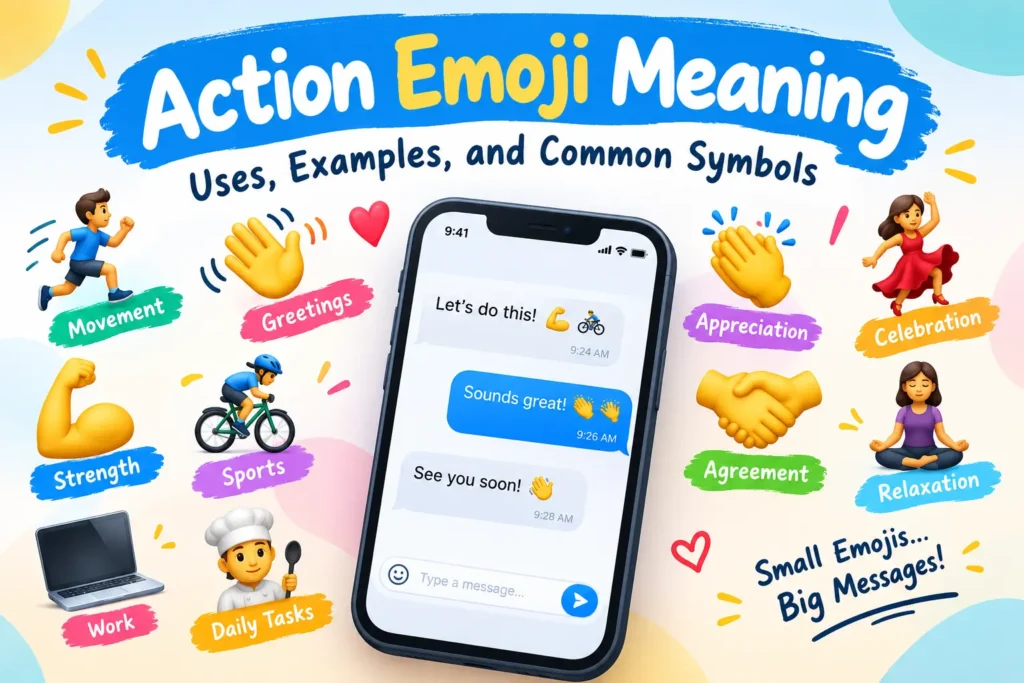
The phrase “action emoji” can refer to emojis that express movement, physical activities, gestures, reactions, or things people do. Unlike a specific emoji such as ❤️ or 😂, action emoji is a broad term rather than the official name of one particular emoji. Its meaning depends on which symbol someone uses.
Action emojis help make digital conversations more expressive. A running emoji can suggest exercise or rushing somewhere, a waving hand can communicate a greeting, and a clapping emoji can show appreciation. These small symbols can add energy and emotion to text messages, social media captions, comments, and online chats.
If you are searching for an action emoji, you may want to find the right symbol for a particular activity, understand what someone means by sending one, or discover which emojis work best in a message. It also helps to distinguish action emojis from facial expressions and symbols that communicate feelings rather than physical actions.
This guide explains the meaning of action emojis, their main categories, how people use them in conversations, and how to choose the right one for different situations.
Action Emoji – Quick Answer
An action emoji is an emoji that represents a physical action, movement, gesture, sport, activity, or behavior. People use these emojis to describe what they are doing, communicate a reaction, or make a message more engaging.
Examples include:
- 👋 Waving Hand — greeting or saying goodbye.
- 🏃 Person Running — running, exercise, or rushing.
- 👏 Clapping Hands — applause, praise, or appreciation.
- 💃 Woman Dancing — dancing, celebration, or having fun.
- 🙌 Raising Hands — celebration, excitement, or support.
- 🤝 Handshake — agreement, cooperation, or a deal.
- 🚴 Person Biking — cycling or exercise.
- 💪 Flexed Biceps — strength, effort, or encouragement.
The exact meaning depends on the emoji and the surrounding message. Some action emojis describe a literal activity, while others communicate a figurative idea, such as working hard, celebrating success, or supporting a friend.
What Does Action Emoji Mean?
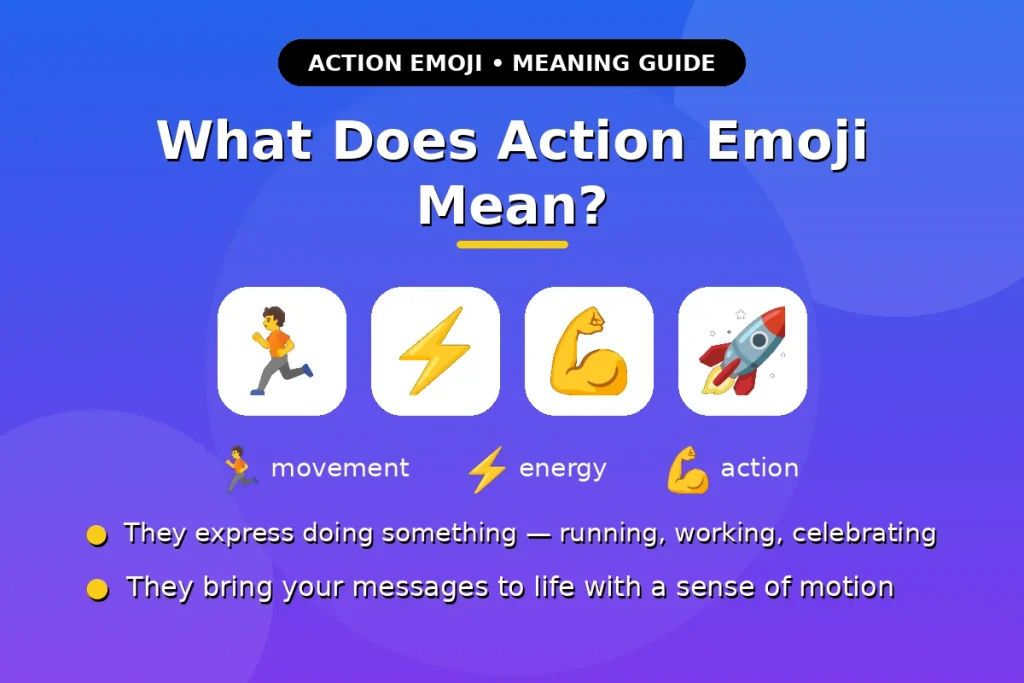
The meaning of an action emoji depends on the action it depicts and the message in which it appears. Some emojis describe something happening in real life, while others communicate feelings, intentions, or social reactions.
For example, consider these common categories.
1. Movement and Physical Actions

🏃 Running
This emoji can describe jogging, exercise, a race, or hurrying to get somewhere. It can also be used humorously when someone wants to leave a situation quickly.
Example: “I’m running late. Save me a seat! 🏃”

🚶 Walking
Often represents walking, taking a stroll, going somewhere on foot, or enjoying a peaceful walk.
Example: “I’m walking to the coffee shop now 🚶”

🚴 Cycling
Commonly used for biking, fitness, outdoor activities, or a cycling trip.
Example: “Saturday morning bike ride 🚴”
2. Hand Gestures and Social Actions

👋 Waving Hand
A friendly greeting, goodbye, or way to get someone’s attention.
Example: “Hey, Emily! 👋”

👏 Clapping Hands
Expresses applause, congratulations, appreciation, or approval. Between friends, it can also be used sarcastically, depending on the words around it.
Example: “You finally passed your exam! 👏”

🤝 Handshake
Represents agreement, teamwork, cooperation, or a deal.
Example: “We have a plan. It’s official 🤝”
3. Exercise, Sports, and Strength
These action emojis help people discuss workouts, sports, challenges, and personal achievements.
- 💪 Flexed Biceps: Strength, determination, hard work, or encouragement.
- 🏋️ Person Lifting Weights: Weight training, gym sessions, or fitness goals.
- 🏊 Person Swimming: Swimming, water sports, or exercise.
- ⚽ Soccer Ball: Soccer games, sports, or team enthusiasm.
- 🏆 Sports Medal or Trophy: Achievement, victory, or recognition.
- 🧘 Person in Lotus Position: Meditation, mindfulness, relaxation, or yoga.
For example, “First day back at the gym 💪” uses an action-related symbol to express effort and motivation rather than simply describe a body movement.
4. Dancing, Celebration, and Fun
Some action emojis communicate a lively mood or a social activity.
- 💃 Woman Dancing — dancing, celebration, or excitement.
- 🕺 Man Dancing — dancing, nightlife, or having fun.
- 🙌 Raising Hands — celebration, praise, or excitement.
- 👏 Clapping Hands — applause and recognition.
- 🤸 Person Cartwheeling — gymnastics, athletic movement, or playful energy.
A message such as “We got the tickets! 💃🎉” uses movement and celebration symbols to communicate excitement.
5. Work, Creativity, and Everyday Tasks
Action-related emojis can also represent routine activities or practical tasks.
- ✍️ Writing Hand — writing, taking notes, or completing paperwork.
- 💻 Laptop — working, studying, or using a computer.
- 🧑🍳 Cook — cooking or preparing food.
- 🧹 Broom — cleaning or tidying up.
- 📚 Books — studying, reading, or learning.
- 🔨 Hammer — building, repairing, or working on a project.
These examples show why action emojis are not limited to sports or physical movement. People also use them to make everyday plans and activities easier to understand.
What Does Action Emoji Mean in Texting and Chat?
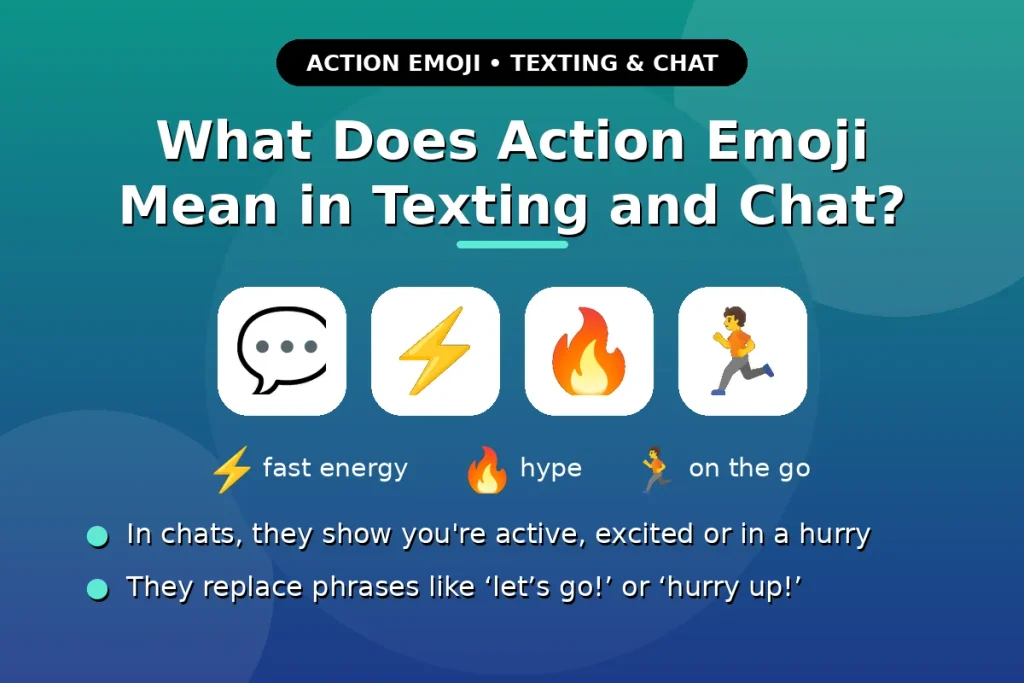
In texting, action emojis often add information that would otherwise require extra words. They can describe what someone is doing, show a reaction, or make a message sound more playful.
The same emoji can have a literal and a figurative meaning.
| Message | Possible meaning |
|---|---|
| “Heading home now 🚶” | Literally walking or traveling home. |
| “I need coffee before work ☕” | Describing a routine or current need. |
| “You did it! 👏” | Praise or congratulations. |
| “I’m so ready for the concert 💃” | Excitement and anticipation. |
| “Let’s make a deal 🤝” | Agreement or cooperation. |
| “Time to get back to work 💪” | Determination and motivation. |
On WhatsApp and iMessage
In private messaging apps such as WhatsApp and iMessage, the emoji usually takes its meaning from the surrounding conversation.
If a friend asks what you are doing and you reply “Running 🏃,” the emoji probably describes an activity. If your friend says, “You finished the entire project in one day?” and you reply “💪,” it may communicate pride or determination.
A single emoji can also serve as a quick response. For example, 👏 can acknowledge a friend’s achievement without requiring a long message.
In Messenger and Direct Messages
In Messenger and social media DMs, action emojis may be used for greetings, playful reactions, invitations, and encouragement.
- “Are you coming to the game? ⚽”
- “See you there! 👋”
- “You have this interview in the bag 💪”
- “Deal? 🤝”
The important distinction is that an action emoji does not automatically reveal a hidden emotion. Its meaning is usually best understood alongside the words and the relationship between the people communicating.
What Does Action Emoji Mean From a Girl?
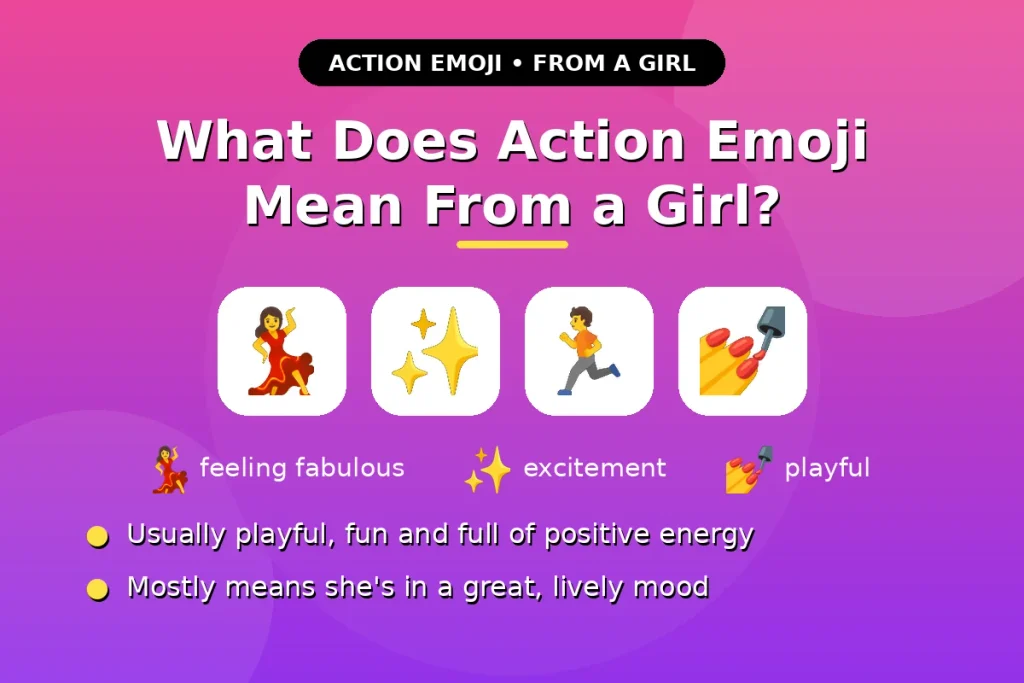
If a girl sends an action emoji, its interpretation depends on the specific symbol, her message, and your relationship.
For example:
- 👋: She may be greeting you, saying goodbye, or starting a conversation.
- 👏: She may be congratulating you or showing appreciation.
- 💪: She may be encouraging you or expressing confidence in you.
- 💃: She may be excited about a plan, party, or event.
- 🤝: She may be agreeing with you or confirming a plan.
If she sends “Can’t wait to see you 💃,” the combination of the words and emoji suggests excitement. It could be friendly or romantic, depending on your relationship.
If she sends “Good luck today 💪,” the more natural interpretation is encouragement.
An action emoji by itself is not proof of romantic interest. Look at whether she initiates conversations, how she responds to you, and what she actually says rather than trying to decode a single symbol.
What Does Action Emoji Mean From a Guy?
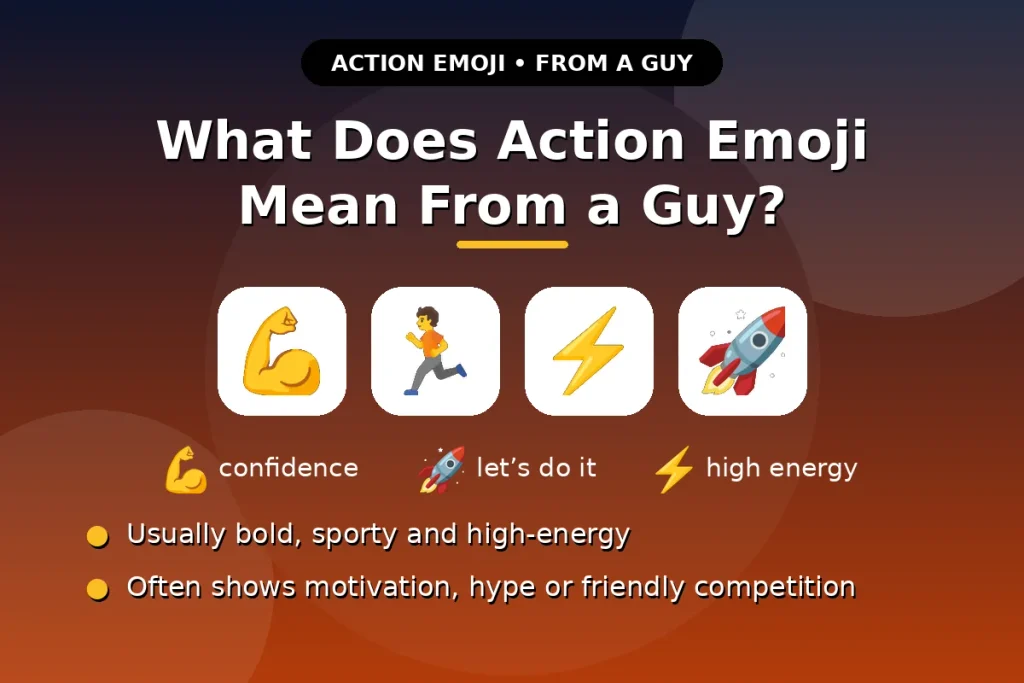
A guy may use action emojis to describe activities, show support, joke around, or express excitement.
For instance:
- “Made it to the gym 💪” may indicate fitness or motivation.
- “Bro, that was incredible 👏” may express admiration.
- “See you tomorrow 👋” is a casual greeting or goodbye.
- “Let’s do it 🤝” may confirm an agreement.
- “We’re going to win this game ⚽” communicates enthusiasm about sports.
In a romantic conversation, an emoji may add warmth or playfulness to an invitation. However, it is not reliable evidence of attraction without other signs of interest.
A guy sending 💪 to a friend might simply be offering encouragement. The same emoji sent after discussing a difficult personal goal may mean, “Keep going; you’ve got this.”
Meaning Between Friends
Action emojis are particularly useful between friends because they communicate reactions quickly and naturally.
Friends may use them to:
- Celebrate good news with 🙌 or 👏.
- Encourage each other with 💪.
- Say hello or goodbye with 👋.
- Confirm a plan with 🤝.
- Discuss exercise with 🏃 or 🚴.
- Joke about being late with 🏃♂️ or 🏃♀️.
For example, if your friend finishes a difficult exam and you reply “You crushed it! 👏🔥,” the emojis reinforce praise and excitement.
Some gestures can also be playful or sarcastic. A friend who sends 👏 after you make an obviously silly mistake might be teasing you rather than genuinely applauding. The conversation helps distinguish the two.
Meaning in a Romantic Relationship
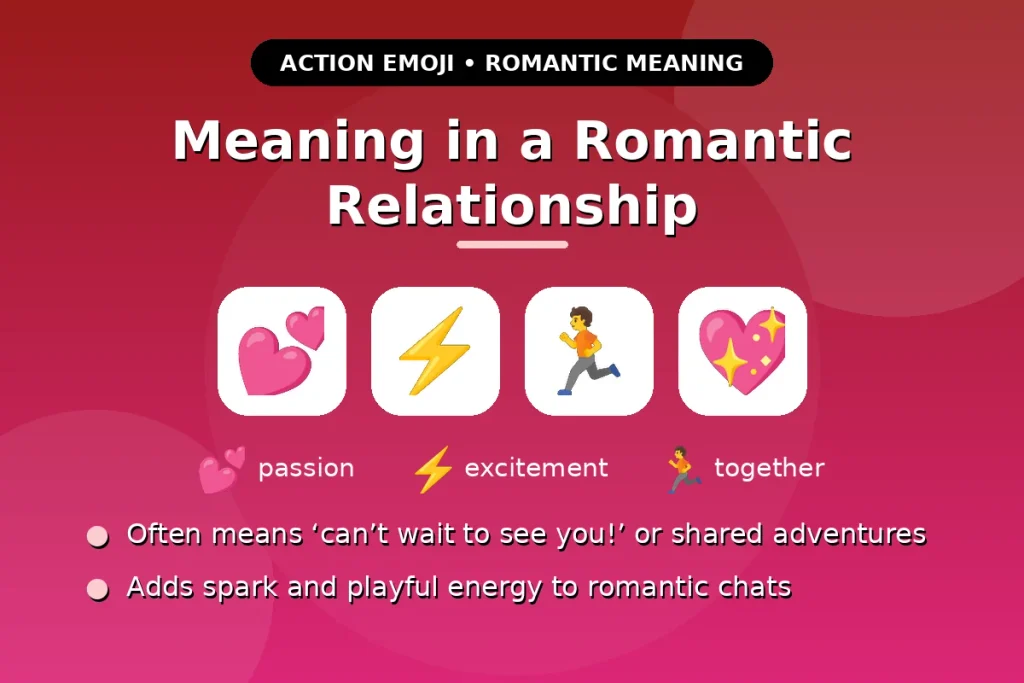
Couples can use action emojis to express excitement, affection, encouragement, and shared activities.
For example, 💃 may accompany a date-night invitation, 👋 can be part of a casual greeting, and 🙌 may celebrate a shared achievement. 💪 can show support when a partner is working toward a goal.
Consider this message:
“Can’t wait for our date tonight 💃❤️”
The dancing emoji adds excitement, while the heart contributes a more clearly affectionate tone.
Action emojis are not inherently romantic, though. A handshake or running emoji is generally more about agreement or activity unless the surrounding conversation gives it another meaning.
Meaning Between Family Members
Families use action emojis to coordinate everyday plans and celebrate milestones.
- 👋 — greeting a parent or sibling.
- 💪 — encouraging someone before an exam or important event.
- 👏 — celebrating a child’s achievement.
- 🧹 — reminding someone about chores.
- 🍳 — talking about preparing a meal.
- 🙌 — celebrating good family news.
For example, a parent might text, “Good luck at your first day of work! 💪❤️” The flexed biceps communicates encouragement, while the heart expresses affection.
An action emoji can make a short family message feel more personal without changing its basic meaning.
Meaning Between Colleagues or Coworkers
At work, action emojis can help communicate progress, appreciation, agreement, and teamwork. Their suitability depends on workplace culture and the formality of the conversation.
Generally useful examples include:
- 👏 — acknowledging a colleague’s achievement.
- 🤝 — confirming cooperation or an agreement.
- 💪 — encouraging a team before a demanding task.
- ✍️ — indicating that notes or documentation are being prepared.
- 🙌 — celebrating a completed project in an informal team chat.
For example, “Great work on the presentation, everyone 👏” is a natural expression of appreciation in many informal work settings.
For a formal client email, a plain written acknowledgment may be more appropriate. A casual or celebratory emoji can sometimes distract from a serious message, so follow the communication style of the people involved.
Action Emoji Meaning on Social Media
Action emojis can have slightly different roles depending on where you use them. The symbol itself stays recognizable, but the caption, video, audience, and conversation can change how people interpret it.
On Instagram, action emojis often appear in Reels captions, Stories, comments, and DMs.
- 💃 for a dance video, party, or night out.
- 🏋️ for workout posts and fitness updates.
- 👏 for congratulating a creator.
- 🙌 for celebrating a personal milestone.
- 👋 for greeting followers or welcoming someone.
For example, a caption such as “New personal record today 💪” connects the emoji with achievement and determination.
TikTok
On TikTok, action emojis can complement dance challenges, sports clips, fitness routines, comedy videos, and demonstrations of everyday activities.
A creator might use 🕺 in a dance-video caption or 🏃 in a funny clip about rushing to catch a bus. In these cases, the emoji reinforces the visual joke or activity.
Snapchat
On Snapchat, action emojis often appear in casual conversations about plans and daily routines. Someone might send 🚴 to say they are cycling or 👋 to signal that they are leaving.
If you receive an action emoji in a Snap, use the image, caption, and preceding conversation to interpret it rather than relying on the symbol alone.
On Facebook, action emojis can help people react to family updates, community events, sports results, and personal achievements. 👏 may show congratulations, while 🙌 can communicate celebration.
WhatsApp and iMessage
These messaging apps are especially useful for sharing quick updates. An emoji such as 🏃, 🚗, or 👋 may communicate what someone is doing without a lengthy explanation. In group chats, 🙌 and 👏 can help everyone celebrate an announcement or achievement.
Real Conversation Examples: Action Emojis in Everyday Messages
These examples use familiar American English names and natural texting situations to show how the same action emoji can communicate different things.
1. Between Friends
Emily: “I finally finished my 5K this morning!”
Jake: “That’s awesome! 👏💪”
Meaning: Jake is congratulating Emily and recognizing her effort. The clapping emoji expresses praise, while the flexed biceps emphasizes strength or accomplishment.
2. A Romantic Conversation
Sarah: “Dinner at 7, and then we can go dancing?”
Michael: “I’m in! 💃🕺”
Meaning: The dancing emojis communicate enthusiasm about the plan. They support the romantic context, but the words and relationship—not the emojis alone—establish the date’s meaning.
3. A Family Message
Mom: “Your sister got accepted into her first-choice college!”
Daniel: “No way! 🙌👏”
Meaning: Daniel is celebrating his sister’s achievement. The emojis express excitement, happiness, and congratulations.
4. Encouraging Someone
Ashley: “I’m nervous about my job interview tomorrow.”
Ryan: “You’ve prepared so much. You’ve got this 💪”
Meaning: Ryan uses the flexed biceps to communicate confidence and encouragement. It is a supportive gesture rather than a literal reference to physical strength.
5. Showing Appreciation
Megan: “I covered your shift so you could make it to the appointment.”
Lauren: “You saved me today. Thank you! 🙌”
Meaning: Lauren is expressing relief and appreciation. Here, the raised hands communicate a positive reaction to Megan’s help.
6. A Social Media Comment
Olivia: “First dance competition completed! 💃”
Noah: “You absolutely crushed it 👏🔥”
Meaning: Noah is praising Olivia’s performance. The clapping emoji signals applause, and the fire emoji adds enthusiasm.
7. Casual Texting
Ethan: “Where are you?”
Chris: “Walking over now 🚶”
Meaning: The walking emoji provides a quick visual description of Chris’s activity. There is no hidden emotional message implied by the symbol.
8. Confirming a Plan
Jessica: “I’ll bring the snacks if you bring the drinks.”
Amanda: “Deal 🤝”
Meaning: The handshake communicates agreement and cooperation. It is a natural way to confirm a plan between friends.
Action Emojis Compared With Similar Emojis
Action emojis sometimes overlap with facial expressions, heart emojis, and symbols of celebration. Understanding the differences can help you select an emoji that matches your intended tone.
| Emoji | Name | Common meaning | Typical tone |
|---|---|---|---|
| 👋 | Waving Hand | Greeting or goodbye | Friendly |
| 👏 | Clapping Hands | Applause or praise | Appreciative |
| 🙌 | Raising Hands | Celebration or praise | Excited |
| 🤝 | Handshake | Agreement or cooperation | Collaborative |
| 💪 | Flexed Biceps | Strength or determination | Motivational |
| ❤️ | Red Heart | Love or affection | Warm or romantic |
| 😊 | Smiling Face With Smiling Eyes | Happiness or friendliness | Cheerful |
| 🎉 | Party Popper | Celebration or good news | Festive |
| 🔥 | Fire | Excitement, excellence, or intensity | Energetic |
👏 vs. 🙌
Both emojis can celebrate an achievement, but they emphasize different reactions.
- 👏 Clapping Hands usually suggests applause, praise, or recognition.
- 🙌 Raising Hands often suggests excitement, celebration, or a feeling of success.
For example, “Great presentation 👏” focuses on appreciation, while “We finally finished the project! 🙌” emphasizes shared excitement.
💪 vs. ❤️
These emojis communicate different kinds of support.
- 💪 often represents strength, perseverance, motivation, or effort.
- ❤️ commonly represents love, affection, or emotional warmth.
If a friend has an important exam, 💪 can communicate encouragement. If you want to express affection for a family member, ❤️ may be more direct.
👋 vs. 😊
The waving hand represents a gesture, usually a greeting or farewell. The smiling face expresses a positive facial expression or friendly emotion.
“Good morning 👋” emphasizes greeting someone, while “Good morning 😊” adds a cheerful or warm tone.
💃 vs. 🎉
The dancing emoji is useful when the message involves dancing, nightlife, or energetic fun. The party popper is broader and can celebrate birthdays, promotions, graduations, and other milestones.
You can combine them when appropriate: “Graduation night! 💃🎉”
Official Unicode Information About Action Emojis
One important distinction is that “action emoji” is a descriptive category, not the official Unicode name of one specific emoji.
Unicode assigns names to individual emoji characters and sequences. For example, 👏 is called “clapping hands,” 🙌 is “raising hands,” 🤝 is “handshake,” and 🏃 is “person running.” These names and their associated keywords can be checked in the official Unicode Emoji List.
Unicode
Action-related symbols appear across several emoji groupings, including people and body parts, hand gestures, activities, sports, and celebrations. Emojipedia also provides browsable collections of activity emojis and hand gestures.
Emojipedia
+1
A few details are worth remembering:
- Unicode name: The standardized name for an emoji character or sequence.
- Emoji appearance: The visual design shown by a particular platform or device.
- Everyday meaning: How people use and interpret the emoji in a conversation.
- Emoji version: The version of the Unicode emoji standard in which an emoji was included.
The emoji’s official name does not capture every possible conversational meaning. For instance, 🏃 depicts running, but people may use it jokingly to suggest leaving quickly or rushing to complete a task.
Some person emojis also have gender variants and optional skin-tone modifiers. Their visual appearance can differ across operating systems and applications, even when they represent the same underlying emoji. For accurate technical details, consult Unicode’s charts rather than assuming every platform displays symbols identically.
Common Mistakes When Using Action Emojis
Even simple emojis can be misunderstood if the sender and receiver interpret them differently.
1. Assuming Every Action Emoji Is Literal
A running emoji does not necessarily mean someone is physically running. It might be a joke about being late, leaving a situation, or rushing through work.
2. Confusing Celebration With Appreciation
👏 and 🙌 overlap in meaning, but they can emphasize different reactions. Choose the one that most closely matches your intended message.
3. Assuming an Emoji Reveals Romantic Interest
A person sending 💃, 👋, or 🙌 is not necessarily flirting. These symbols often have ordinary social meanings.
4. Ignoring the Words Around the Emoji
The message “Great job 👏” usually expresses praise. The same emoji after a sarcastic remark might communicate mock applause instead.
5. Treating Every Platform’s Appearance as Identical
An emoji’s design may vary across Apple, Google, Samsung, and other platforms. Small visual differences can affect how a gesture looks.
6. Overusing Emojis in Formal Messages
Several celebratory symbols may suit a group chat but distract from a formal business email. Consider your audience and the tone of the conversation.
When Should You Use an Action Emoji?
Action emojis work best when they make your message clearer, friendlier, or more expressive.
Use them when you want to:
- Describe an activity: “Heading to the gym 🏋️”
- Greet someone: “Hey, everyone! 👋”
- Celebrate success: “We did it! 🙌”
- Congratulate a friend: “Amazing job on your presentation 👏”
- Encourage someone: “Keep going. You’re getting stronger 💪”
- Confirm an agreement: “Sounds like a plan 🤝”
- Share a hobby: “Morning bike ride 🚴”
- Add energy to a caption: “Dance floor ready 💃”
The best approach is to choose the symbol that matches the message. If the emoji adds a clear visual cue or conveys a reaction that would otherwise take extra words, it is probably useful.
When Should You Avoid an Action Emoji?
There is no universal rule against using action emojis, but certain situations call for more care.
- Formal communication: Avoid overly casual emoji combinations in official applications, serious business proposals, or formal client correspondence unless the relationship permits them.
- Sensitive conversations: If someone shares difficult news, a celebratory emoji may appear insensitive or dismissive.
- Unclear agreements: A handshake emoji can suggest agreement, but it should not replace an explicit written confirmation when important terms need to be documented.
- Potentially ambiguous gestures: Some hand gestures can have different cultural or conversational interpretations. Use clear wording if the message could be misunderstood.
- Excessive decoration: A long string of unrelated emojis may make your message harder to understand.
When the situation is serious, words should carry the essential meaning. Emojis can add warmth or emphasis, but they should not obscure what you intend to communicate.
Frequently Asked Questions About Action Emojis
1. What is an action emoji?
An action emoji is a symbol used to represent movement, gestures, activities, sports, or behavior. Examples include 👋 for waving, 🏃 for running, 👏 for clapping, and 💪 for strength or determination.
2. What is the most common action emoji?
There is no single universally recognized most common action emoji. 👋, 👏, 🙌, and 💪 are useful examples because they communicate greetings, appreciation, celebration, and encouragement.
3. What does an action emoji mean in texting?
In texting, an action emoji can describe what someone is doing or express a reaction. For example, 🏃 may mean running or rushing, while 👏 can communicate congratulations. The surrounding message helps establish the intended meaning.
4. What does it mean when a girl sends an action emoji?
It depends on the emoji and conversation. A girl sending 👋 may be greeting you, while 💪 may express encouragement. Neither symbol automatically indicates romantic interest.
5. What does it mean when a guy sends an action emoji?
A guy might use an action emoji to describe an activity, show support, celebrate an achievement, or confirm a plan. Interpret it based on the actual message and your relationship.
6. Are action emojis romantic?
Some can appear in romantic conversations, particularly when paired with affectionate wording or heart emojis. However, most action emojis have broader meanings and are also used between friends, family members, and coworkers.
7. Can I use action emojis with friends?
Yes. Action emojis are useful for greeting friends, congratulating them, discussing hobbies, making plans, and encouraging them. 👋, 👏, 🙌, and 💪 are versatile choices.
8. What does the action emoji mean on Instagram?
On Instagram, action emojis often complement Reels, Stories, captions, comments, and DMs. For example, 💃 can accompany a dance video, 👏 can praise a creator, and 🏋️ can represent a workout.
9. What is the difference between an action emoji and an emotion emoji?
An action emoji primarily depicts a gesture, movement, or activity, whereas an emotion emoji primarily communicates a feeling or facial expression. Some emojis overlap: 👏 depicts clapping but can also express appreciation.
10. Are action emojis the same on every phone?
Their underlying Unicode characters are standardized, but their artwork can vary between platforms and devices. Small differences in appearance do not necessarily change the emoji’s basic identity, although people may interpret a particular design differently.
11. Can an action emoji have a sarcastic meaning?
Yes. For example, 👏 may express genuine applause or sarcastic approval, depending on the words, relationship, and tone of the conversation.
12. How do I choose the right action emoji?
Start with the message you want to communicate. Use 👋 for a greeting, 👏 for praise, 🙌 for celebration, 🤝 for agreement, or 💪 for encouragement. If the intended meaning could be unclear, add a few words to explain it.
Conclusion
An action emoji is a useful way to represent movement, gestures, activities, and everyday behavior in digital communication. Symbols such as 👋, 🏃, 👏, 🙌, 🤝, and 💪 can make messages more expressive while helping people communicate quickly.
The meaning of an action emoji depends on its context. A waving hand may be a simple greeting, clapping hands can express appreciation or sarcasm, and a flexed biceps can communicate either physical strength or emotional encouragement. On social media, these emojis can add personality to captions, comments, and videos. In private conversations, they can make everyday messages feel warmer and more engaging.
It is also important to remember that action emojis do not automatically signal romantic interest or carry the same meaning in every situation. The sender’s words, your relationship, and the tone of the conversation all matter.
For the best results, choose an emoji that matches your intention. Use it to clarify your message, add an appropriate reaction, or express an activity naturally. When an emoji might be misunderstood, a short explanation is often all you need.

Alex Carter is a writer and content contributor at ReadEmoji.com. He focuses on explaining emoji meanings, common usage, and digital communication in a simple and easy-to-understand way. His goal is to help readers quickly understand what popular emojis mean and how they are commonly used in everyday conversations.